From the Past
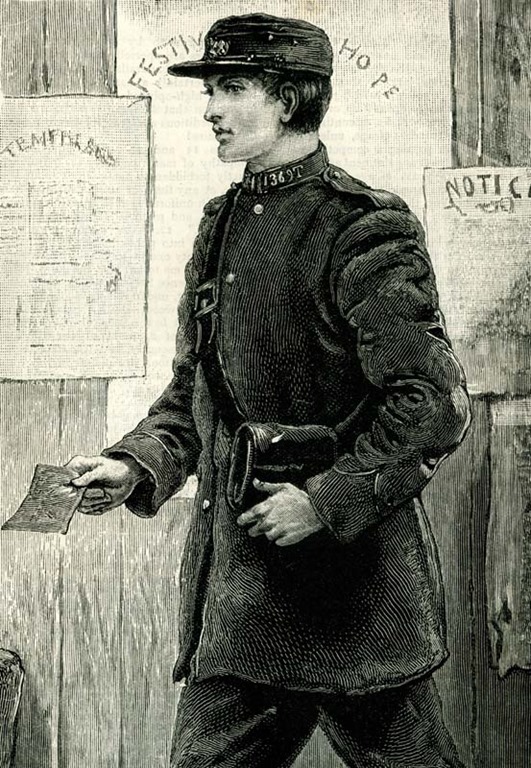
On her Majesty’ Service
by Frederick Sherlock:
Everybody knows the telegraph messenger. All over the kingdom, in town and country, his bright, smart uniform is to be seen and, next to the postman, no public servant of the Queen is more in request. His office is one of great responsibility and usefulness; and if on any given day the electric telegraph suddenly came to an end, business would speedily become disorganised, and a great inroad would also be made upon the happiness of many homes.
The messenger has no knowledge of the contents of the brown envelopes which are put into his hands to deliver with all speed. When he knocks at the door and hands in his message, he cannot tell whether he is a bearer of good news or ill. Sometimes his visit means nothing but sorrow. It may be the loss of the breadwinner by a fatal accident; or the news of a loved soldier son’s death in a far-off clime; or the tale of an attached daughter’s end in a London hospital after a lingering disease. Ah, well! for good or ill the telegraph messenger bustles about day after day, proud to be in Her Majesty’s service, and conscious that his calling is of real use to the community.
The conditions on which boys are taken into the service are not without interest. The limits of age are from 13 to 15.
Candidates between 13 and 14 must be at least four feet seven inches in height, without boots, and candidates between 14 and 15 not less than four feet eight inches. They must have passed Standard V of the new Educational Code, or some equivalent test, and are required to produce a satisfactory certificate of health from their own medical attendant, and certificate of having been satisfactorily vaccinated within the last seven years.
Duty does not commence, as a rule, before 8am and it continues for nine hours. The wages are 7s a week, rising by 1s a week annually to 11s, and uniform is supplied, including boots. All candidates have to sign a declaration, stating they are fully aware that this employment will not entitle them to promotion, compensation, or pension. That their services will be discontinued on their attaining 16 years of age, unless they then succeed in passing a competitive examination for direct appointment as postmen on reaching 18 years of age, or elect to remain two years longer as messengers, on the understanding that if they then enlist as soldiers, they shall, after serving the prescribed time with the colours, have preference over soldiers who have never been in the service of the Post Office, in obtaining employment in that department.
The other day I had a peep at the small Blue Book of ‘Instructions for Messengers in London’, which each messenger is required to produce at every inspection, and also whenever asked for by the messenger’s superior officer. The instructions cover conduct and delivery. Rule 6. ‘You are at all times to keep yourself scrupulously clean, and to have your hair short and neatly cut.’ Or Rule 9… ‘You must take off your cap when in the Office, and you must always be respectful in your manner when spoken to by any person.’ City messengers are specially cautioned against sliding down handrails of the staircases! This is certainly a hard saying, for most health, high-spirited lads are under the impression that sliding down the handrail is an expeditious and graceful way of coming downstairs!
Rules 11 and 12 will command the sympathy of many people. 11. ‘You are strictly forbidden to smoke in or abut the Office, at any time, or in the streets when you are in uniform. Gambling, raffling, playing cards, and practical joking are strictly prohibited’. 12. ‘You must not, on any account, go into public-houses during your hours of duty except to deliver telegrams,’ which leads me to say that the Post Office.
At Christmas time severe temptations are placed in the way of the postmen and telegraph messengers. The ‘Christmas Glass’ has been the ruin of many fine fellows. Let us hope that this year the Christmas box to the postman and to the telegraph messenger will be in current coin, so that the receiver may take it home, and spend it in the way he thinks best, or put it by in the Savings Bank for the rainy day which is sure to come when least expected.
From Church Monthly 1893, pp336-338. with permission of Aysgarth PCC. The illustration was drawn by H Johnson
From The Church Monthly: In April and May 1892 the Vicar of Aysgarth, the Rev Fenwick Stowe, reported on how a ‘miners’ strike’ had affected the train service in Wensleydale, and the Rev Theodore Wood recounted how he had a ‘duet’ with a nightingale.
The Rev Stowe wrote in the Aysgarth Parish Magazine in April: ‘ The principal event of March in our Parish was the Confirmation on the 18th. It had been arranged for our [35] candidates to go to Askrigg, but three days before the date fixed the afternoon trains were taken off, and the Bishop of Ripon most kindly consented to hold an additional Confirmation here, as we could not vey well go to Askrigg. So the great miner’s strike was productive of some good after all. The Bishop gave a most beautiful address and everything passed off as well as possible.’
It is likely that the Rev Stowe was referring to the closure of the Durham mines from February until June 1892. In 1891 the Durham Coalowners Association had proposed reducing the miners’ wages by 15 per cent as the low price of coal had led to a loss of profits. In January 1892 Durham Miners’ Association refused to accept any reduction in wages or to go to arbitration. So, on February 27, the owners closed the mines. The man who mediated the settlement three months later was the Bishop of Durham, the Rt Rev Brooke Foss Westcott. The owners agreed not to reduce wages by more than 10 per cent and that no miners would be victimised. Bishop Westcott was known for taking a practical interest in the miners. His last sermon was at Durham Cathedral during the service for the Durham Miners’ Gala on July 20 1901 and he died on July 27.
Nightingale
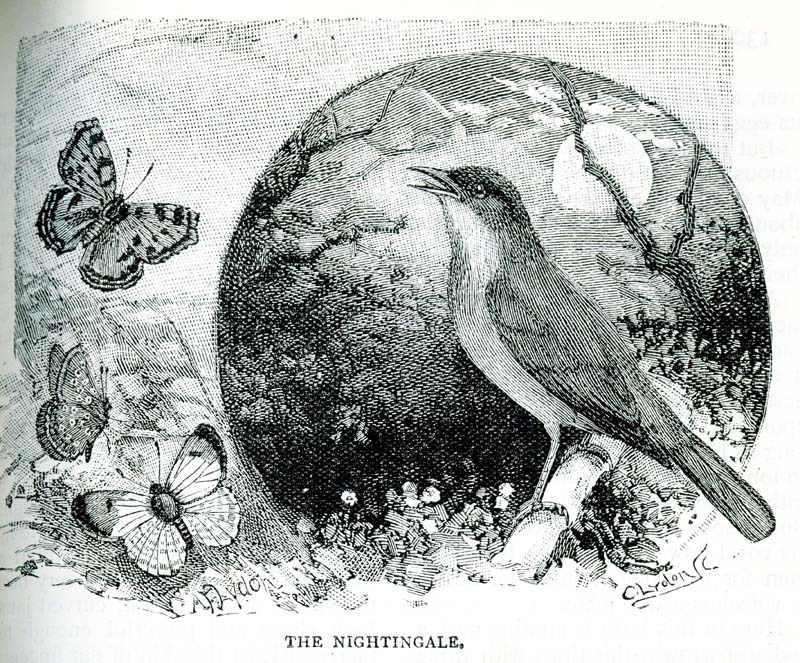
From Rev Wood’s An April Ramble:
"If our ramble takes place after the 15th of the month we ought to hear the nightingale; provided, of course, we dwell in a part of the country which nightingales favour with their summer residence. It is quite a mistake to suppose that these birds only sing by night; for they sing at almost any hour of the 24, if only they are far enough removed from the dwellings of man.
"I always challenge them to a competition by whistling a few soft notes, and then waiting for an answer. In a few seconds, at the most, this always comes: for the nightingale is very proud of his own vocal powers, and ever ready to enter the lists with a competitor. So we whistle and reply to one another, the bird and I, for a minute or two, and then the nightingale grows excited and comes a little nearer; and we carry on the duet until he comes nearer still, and finds out the trick that has been played upon him. And then, I regret to say, he gives vent to a perfect torrent of abuse, in tones which no one would ever have imagined could possibly have proceeded from a nightingale’s throat.
"Shakespeare tells us that the hen bird is the vocalist.
‘The nightingale, if she should sing by night,
When every goose is cackling, would be thought
No better a musician than the wren.’
"But here Shakespeare is wrong, for it is the cock only that sings; and his impassioned strains seem designed first to win the heart of his little brown lady-love, and then to cheer her as she patiently sits on her five olive-green eggs.
From A May Ramble: "A nightingale is singing away merrily. Somewhere hard by, but so cleverly hidden that it takes a keen eye to detect it, is his nest, with his homely little mate sitting upon her eggs. So long as her labour of love continues, so long will he continue to cheer her with bursts and snatches of melody. But as soon as the little ones appear his vocal powers will leave him; and then for ten long months he will be as voiceless as his mate.
"Here … is another nest, a hedge-sparrow’s, this time with three pretty pale blue eggs already gleaming out upon the warm lining of moss and hair. Let us hope no wandering cuckoo will detect it, and place one of its own eggs therein; for in that case the poor hedge-sparrow will lose all hope of bringing up her family. The young cuckoo, almost as soon as he is born, will realise that there is not sufficient room in the nest for its rightful occupants as well as himself; and, taking advantage of his superior strength, he will push them over the side, one after another, until he is left alone in the usurped dwelling. Strange to say the bereaved hedge-sparrows seem careless of the fate of their offspring, and bring all the food which should have gone into the five little gaping beaks to be devoured by the murderous cuckoo! The mother cuckoo, meanwhile, having laid her egg, seems to lose all further interest in it, and never comes near the nest again; so the parent and child remain for ever strangers.
"I once found two cuckoo’s eggs in the same nest – a very rare event. I wondered if both cuckoos had hatched out? Probably they would first have thrown out their fellow-nestlings, and then have had a duel, in the course of which the weaker of the two would have shared the same fate. For the young cuckoo grows so fast that in a very short time there would have been no room in the nest for both; and I am quite sure that one pair of hedge-sparrows could never manage to find food enough for two such voracious little creatures.
"What is that bright green inset which flew up from the patch of sandy ground just at our feet? Here is another running rapidly along a foot or two in front. We make a quick dab at it – for it takes to flight almost as readily as a blue-bottle fly – and find that we have captured a tiger-beetle. He tries his very best to bite us, and those big curved jaws look sharp and powerful enough to pierce at least the skin of our fingers; but we know how to hold him, and he has recourse to his other means of defence – a curious odour, vey much like the scent of the sweet briar, which he is able to pour out at will. Having admired his armour of green and bronze and gold we let him go, to resume his ravages among his fellows. For the tiger-beetle is aptly named and is one of the scourges of the insect world."
For more about the Rev Theodore Wood see Memories of a beetle collector
Sources: “The Story of the Durham Miners” by Sidney Webb, The Labour Publishing Co Ltd, 1921
Wikipedia – about Bishop Westcott
“The Church Monthly” including the “Aysgarth Parish Magazine”, April and May 1892 with permission of Aysgarth PCC
Share this: