From the Past
Articles by the Rev Theodore Wood January to April 1900, published in The Church Monthly
When studying the hedgerows near his home in January 1900 Mr Wood asked: “What are these exquisite birds? Quite a little party of them have all flown up together, and now they are ceaselessly flitting from branch to branch, and chattering to one another as they do so.
“They are long-tailed titmice (long-tailed tits) – father, mother, and half a dozen children. Family affection is strong with these little creatures, and the party does not break up when the young are able to fly. Until the following spring they hold together, none ever parting from the others; flying, feeding, roosting together, all in utmost harmony. Then comes the imperious call of a stronger love still, and the little ones fly their different ways, each with the mate of its choosing.
“Now they are all occupied in seeking for prey – insects and their eggs, and such small atoms, which they find in the crannies of the bark. Some are on the branches, some are underneath them; for titmice can cling in every position, and no crack or crevice escapes their eager scrutiny. From many a plague of insect destroyers to they help to save us, and great is the debt of gratitude we owe to themselves and their fellow-workers.
“If we had but time to examine the hedge thoroughly we should find just as much life there as there will be in summer. Only most of it is wrapped in slumber. The bark, the moss, the dead leaves and rubbish, the surface layer of the ground below – they are full of living beings, only waiting the warm breath of spring to rouse them back into active life. And we might return again and again, and yet find plenty of strange creatures, every one affording material for the study of a life-time. For one never comes to the end of the wonders of even an insect’s body. There is something very like infinity in the structure and the history of the tiniest living speck that crawls beneath our feet.”
February
“February is not the pleasantest month in the year for a country ramble in England. The ground, as a rule, is still locked in the iron grip of the frost; the breeze is chill and biting; and when warmer weather follows it brings with it a downpour of ran, so that ‘February fill-dyke’. has become a proverbial expression.
“Yet now and then one has a foretaste of brighter days to come, and as we stroll along this country lane, dank and decaying as may be the herbage with which its banks are clothed, there is yet many a sign to show that Nature is on the point of waking from her long winter sleep, and that even now she is beginning to bestir herself.
“For we meet a butterfly flitting along the road and making the most of a passing glimmer of sunshine. It is a Sulphur, which has been slumbering peacefully in some snug retreat for many a long month past, and has been roused for just an hour or two by the genial but unwonted warmth.
“A swarm of winter gnats are dancing in the sunshine. Theirs is a life of enjoyment surely and not a life of work. Yet every one of those happy insects, before it became a gnat, laboured long and perseveringly as a scavenger. Its task was to help in removing the dead and decaying matter with which the face of the earth is teeming. Putrid fungus, rotting vegetation – in these it found its home. Side by side with ten thousand others it laboured steadily on, and by feeding on this foul garbage helped to keep the air pure just as the grubs of the summer gnats help to purify the water.
“It is the poetry of natural history this study of the life-history of the myriad beings which surround us. And a ramble on even a February day, when so few living creatures are stirring, may afford us with food for fruitful meditation for many a long day after.”
"March is a month of which many hard things have been said; and certainly in some seasons it affords us little else than a second edition of winter in an aggravated form. Yet it seldom comes to an end without bringing us a few fine sunny days, when birds are singing and butterflies flitting to and fro, and the breath of spring is in the air. It is a pleasure merely to be alive. And everywhere Nature is as busy as she can possibly be, fresh with the vigour gained from her long winter sleep, and straining every nerve in preparation for the bright and active season that lies before her.
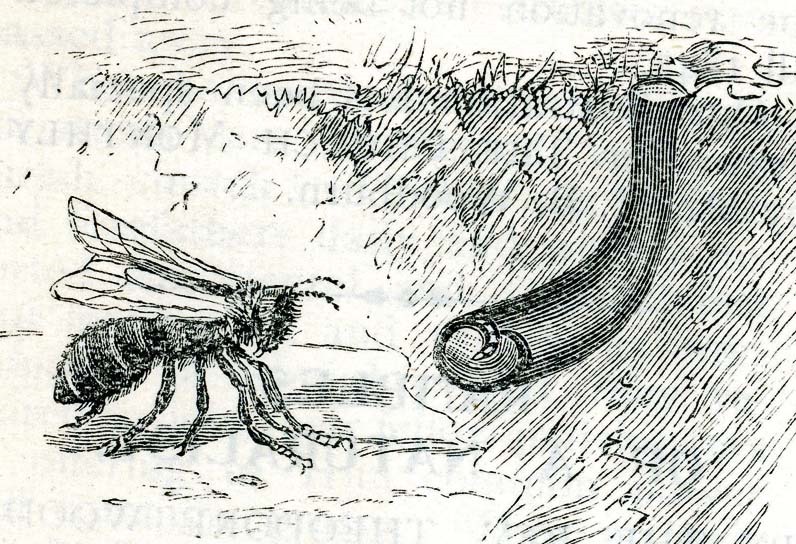
"Do you see those small round holes in the trodden path, each with a tiny pile of crumbled mould around it? Watch one of them for a little while, and you will see a bee come out – a little grey-brown bee, with a round, hairy body and rather short wings. It is a solitary bee (right – from Church Monthly) which is usually engaged in sinking its burrow. It makes no comb; it secretes no wax; it stores up no honey. It just digs a perpendicular tunnel, some eight or ten inches in depth, and then hollows out a few small cells at the bottom. In each of these cells it lays an egg and places a store of provision. Sometimes this provision consists of pollen worked up into ‘bee bread’. For solitary bees do not tend their young as hive and humble bees do. They provide for them once and for all, before they hatch out from the egg-shell; and after that they never visit them again.
"What is this great bluish-black beetle, with tiny wing-cases and a huge, clumsy body which its short little limbs can scarcely drag over the ground? It is an oil beetle and we have only to pick it up to learn the reason for its title; for as we do so a yellow, evil-smelling, oil liquid oozes out from the joints of its legs. In some parts of the country, strange to say, this liquid is regarded as a specific for rheumatism.
"The beetle is on its way to lay its eggs. There are many thousands of these, and it lays them in holes in the ground – four or five thousand, perhaps, in a single hole. In a few days’ time they hatch, and out of each comes a little tiny black grub with six very long legs. Led by some strange instinct, these grubs make their way at once to flowers which [solitary] bees are likely to visit. Then they climb the stems and hid in the blossoms till a bee appears, when they cling to its hairy body, and so are carried back by it, all unknowingly, to its nest. There they live out the rest of their lives, eating both the eggs and the stores which have been supplied for the latter for food.
"Notice the blind-worm gliding through the grass. It is not a snake, although it looks like one and behaves like one. It is not blind, in spite of its name, for it has pair of sharp little black eyes. Neither is it a worm. It is a legless lizard, perfectly harmless, which has been lying torpid throughout the winter, and is now engaged in searching for the tiny white slugs upon which it feeds. We will not handle it, for it is a timid creature, and is given to protect itself, in moments of danger, by snapping off its own tail! The severed member, the nerves of which are evidently highly irritated by this strange mutilation, instantly becomes endowed with singular vitality, and begins to leap and twist about as though possessed of independent existence. And meanwhile, as one’s attention is occupied in watching its antics, the blind-worm creeps away to a place of safety, and there proceeds to grow a new tail.
April
It is something to be thankful for that, even in these days of excursions and cheap trips, there are still spots of ideal beauty which are seldom trodden by the foot of man. Let us ramble through a lonely glen, hidden away among the hills, where Nature reigns unmolested, and beasts and birds and insects dwell in utter security. Its sloping sides are brown with last year’s bracken and green with feathery moss. Here and there are patches of yellow, where primroses cluster together. Under the trees are anemones with their delicate pencilled blossoms and starworts with petals widely expanded.
Did you see that bird dart down the stream – a passing flash of black and white? It was a dipper, and there he is, sitting on a mossy stone in the midst of the water, not twenty yards away. Never was bird more aptly named for, as we watch, he “dips” now and again, and yet again as if he were a little country school-maid curtseying as she meets the parson. He is just like a magnified wren with a white waistcoat. He has just the same jerky movements and just the same little upturned tail. Now he is searching amongst the moss for the little yellow-spotted beetles which hide there. The next moment he has plunged into the water and is hunting for snails and grubs at the bottom. Then, once more, the black-and-white streak flashes past us. He has darted up stream again to join his mate, who is dipping and diving a hundred yards away.
The air is full of the hum of bees. That is because a sallow bush is growing by the side of the water and every branch is laden with golden catkins. There are hive bees from the cottage garden at the foot of the glen, and red-hipped humble-bees from many a moss-covered hollow in the ground, and solitary bees. Most are intent on draining the honey-laden blossoms of their juices for the hungry little ones at home.
But there is a tragedy. One of the bees is weak on the wing. It settles and we examine it and see the reason why. A little white object is projecting from between the segments of its abdomen. That white object is head of a stylops. It stays there and never comes out, and feeds incessantly on the juices of the bee’s body! The ways of parasites are strange. They cling to the lower surface of the beetle’s body; they live inside caterpillars and feed upon their fat; they cause great swellings on the backs of cattle; and they drive even the elephant himself half mad with the torment of their bites. But the ways of this parasite are quite the strangest of all.
The male is an evident beetle with large milk-white wings and odd little branched antennae. But the female, practically speaking, never becomes more than a grub. In the bee’s body she lives; and in the bee’s body she dies.
The glen is full of life – animal life, bird life, reptile life and insect life. It is a panorama of natural beauty as we ramble through it, and a cyclopaedia of natural wonders when we pause to search out its secrets. We might come daily for a week, a month, or a year and not exhaust them all.
Editor’s note:
I like to check the latest reports concerning the creatures that the Rev Wood recorded. There is often more up-to-date information and this is especially true of his account about stylops. He believed the female stylops had its head inside a bee’s abdomen, whereas now it is now that the head is sticking out. So I have slightly edited his account.
It was also sad to learn that since he wrote about oil beetles it is likely that three of the UK’s native ones have become extinct. For more about that see:
https://cdn.buglife.org.uk/2019/08/Oil-Beetle-national-survey-leaflet-for-web_5-species.pdfhttps://www.coleoptera.org.uk/meloidae/home
The Rev Wood’s articles in the Church Monthly are reproduced with the kind permission of Aysgarth Parochial Church Council.
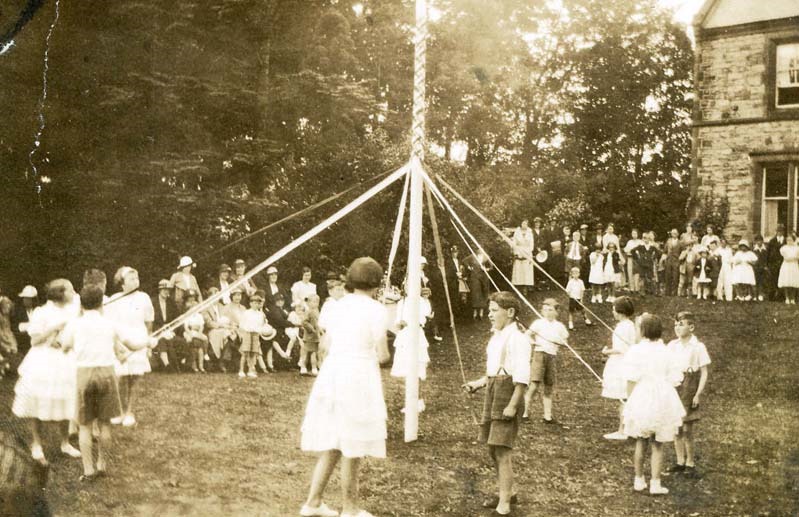
Above: Maypole dancing in the Vicarage garden following a Flower Festival probably in the 1930s.
There was great excitement at St Chad’s Home for Waifs and Strays in 1894 when a large hamper of flowers arrived from Aysgarth (see below). The bouquets had been presented by children at the Flower Service at St Andrew’s Church. A year earlier the Vicar, the Rev Fenwick Stow, reported that 300 children had attended the service. It seems incredible now that there were so many children in Aysgarth parish.
The children came from their small village schools (there were five at that time – at Aysgarth, Carperby, West Burton, Cross Lanes and Bishopdale) not just for the Flower Services but also for the teas and sports at the Vicarage (now Stow House) afterwards. They, with their families and friends, obviously had a great time and as well as bringing a lot of joy into the lives of the girls at St Chads in Headingley, Leeds, as can be seen from this letter published in the August 1894 edition of the Aysgarth Parish Magazine:
Please’m Matron says, will you come down and see the flowers? Oh! they are so lovely, and such lots of ‘em.
I gladly obeyed the summons and went down, and this is what I saw – A large table on which were several buckets filled with flowers of every hue – surrounded by eager faces, some hands-filled with flowery treasures, while those who had not yet secured any looked with longing eyes at the great bunches still unappropriated; but soon there was not a child without a flower, and it was amusing to see what each chose, and to hear the chatter – one little mite rejoicing in a huge peony which she had pinned on her pinafore, and remarking to anybody who would listen to her ‘Oh, my! isn’t it a beauty?’
‘Forget-me-nots,’ says a voice, and there is a rush for the happy finder. ‘Look at my button-hole’ from the irrepressible wearer of the peony – and acting upon the idea thus suggested, the Matron says, “Now, I will give a prize to the girl who makes the prettiest button-hole.’
Great is the excitement and the rush for flowers, and when any one has found a special treasure, one is reminded of the happy chicken in the poultry-yard who has secured a dainty tit-bit, only to be pursued by his envying companions and with neither time nor chance to enjoy the prize. But here there is enough for all, and soon the excitement settles down into earnest business – and now some have finished and everybody thinks everybody else’s is better than theirs, and there is much speculation.
One dark-eyed girl has a really artistic spray, a bunch of pansies, which must have won the prize, only she, alas is in disgrace and so cannot compete.
When all have finished, and their folded names are fastened to their respective bunches, they are laid on white paper, and very pretty they look. ‘Quite a flower show’ someone remarks. Then every one is turned out of the room while the judges (who have not been in the room during the arrangement) perform their office – a difficult one – for the merit is very even . The excitement and impatience outside is extreme, and when we are allowed to come in again, there is dead silence in the orderly line round the room, though the sparkling eyes speak plainly enough.
The momentous decision is given – a sweet little bunch of yellow, white and dead-pink daisies takes the first prize, and two others receive a second and third. Not a murmur of discontent is heard from the unsuccessful ones. They don their bunches, and think themselves very smart indeed. The proposal of a future competition in which the Matrons shall also compete, their exhibits to be judged by the prize-winners among the girls is received with acclamation – and so ends a happy evening.
All this pleasure was the result of a gift of flowers, and we feel sure that who send us, and others, hampers of flowers will like to know how much pleasure they give and how their beauty softens our girls and brightens their lives.
It is much to be wished that our friends at Aysgarth, who so generously responded to their Vicar’s appeal could have been present at St Chad’s Home when their offerings were unpacked. The excitement and interest of the girls and children who were privileged to be present, was fully shared by the Matrons notably by the one-in-charge of the kitchen, who remarked ‘This butter has just come in the nick of time for I had none to send up for tea! Eggs! More eggs! Eggs again! Oh, look a these lovely brown ones – (and at those packed in moss) arn’t they pretty.’
Eggs were the special feature (39 dozen) and much we have enjoyed them since, that is some of them, for the greater number have been subjected to some mysterious process by means of which they will keep till Xmas (always supposing we do not eat them before then).
The clothing was eagerly seized upon by the clothing Matron. The biscuits, sweets, toys, and other good things gladdened the eyes of all, and we felt, as we watched the happy faces and eager hands, what a privilege it was to be able to give so much pleasure.
……….
That year the Rev Stow reported about the Flower Service:
'The Church was full, almost all the children of the parish and many adults were present. Before the sermon, while hymns were being sung, the children marched up the middle aisle each bearing a bouquet of flowers, and many of them also parcels of clothing, eggs, butter, money &c., as offerings in aid of the Society for Providing Homes for Waifs and Strays. In addition about £4 was collected.
'During the service the sun had been shining brightly, but after all had assembled in the Vicarage garden unfortunately a very heavy shower occurred. However, all got their tea either inside the house or out of doors as soon as the rain ceased. After this Miss Hill, one of the secretaries for ‘Waifs and Strays’ spoke a few words before a large and attentive audience about those for whom the society carries on its noble work.
'The company then adjourned to the field in front of the house where the children held their athletic sports. A nice sum was collected for prizes and some exciting races were run. All seemed in good spirits and enjoyed themselves heartily. After a few speeches and cheers the proceedings terminated.
'The flowers were sent, some to the Leeds Infirmary; some to St Chad’s Home for Waifs and Strays; and some to Stockton-on-Tees.'
………
The church has copies of its parish magazine dating back to 1892. In 1892 it was reported: ‘A flower service was held at Aysgarth Church on Thursday June 30th. Each child brought a bouquet of flowers – six hampers of which were afterwards sent to the Leeds Infirmary. After the service the children of the parish and many of their parents and other adult parishioners had tea at the Vicarage. In all about 300 sat down. The weather was fine and it was a bright and pleasant occasion.’
It’s possible that was the first flower service at Aysgarth for the following year the vicar wrote: ‘Our flower service was held on Tuesday June 20. A still larger number of children attended than in 1892. Indeed there was scarcely a child in the parish absent. The quality of the flowers showed improvement. Many of our young friends must have taken a great deal of trouble to procure such charming bouquets.’ A shortened form of service was used and the address (by the Precentor of Ripon Minster) was ‘simple but admirable’.
'Everyone – including 300 children – then adjourned to the Vicarage garden for tea and an afternoon of sports organised by the ‘gentlemen of the parish’ who gave handsome prizes to the boys and girls. And at the end of the afternoon each child was presented with a toy. These included 100 dolls which had been dressed at the Vicarage with the assistance of a ‘working party’ of friends. These, it was said, ‘delighted the motherly hearts of the little girls’. The other gifts included bats, balls, scissors, work baskets and musical instruments.
The Rev Stow added: “Quite a number of parishioners gave gratuitous help on the occasion which was indeed everybody’s treat.’ Two hampers of flowers were sent that year to the Leeds Infirmary and one to the York County Hospital.
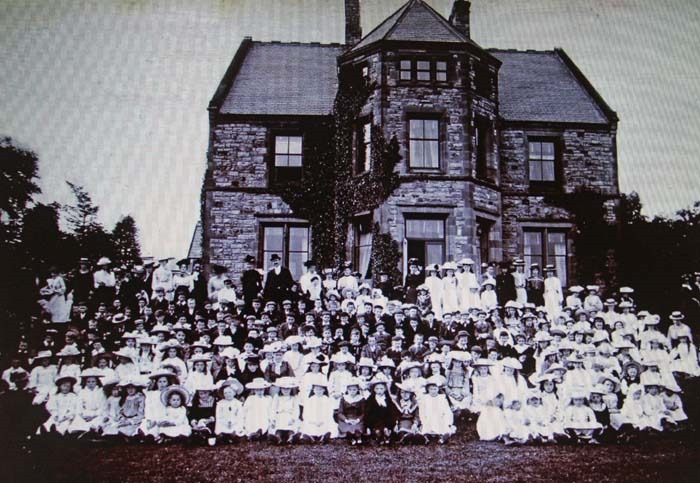
Below: a group photo outside the Vicarage (Stow House) around 1900.
The following year the church began supporting St Chad’s for, as the Rev Stow said in 1895, the flower service provided an ‘opportunity for our children who have happy homes to contribute to the welfare of those poor children who have no homes, or those who, whether they have homes or not, are cruelly treated. Children are invited to bring as offerings eggs or butter, toys or articles of clothing, or anything else ornamental or useful, in addition to their bouquets of flowers.’
Even more children attended the service in 1895 and the fun, the vicar said, carried on till after sunset. In June 1898 the entertainment went on into the evening thanks to a concert by the West Burton Brass Band. The Rev Stow commented again on how so many helped to make the day so successful and enjoyable. And that year participants could buy copies of photographs of those at the tea and sports.
No flower services were held during World War I but were resumed in 1919. For many years after that war the music in the evening was provided by the Hawes Band. It is not clear when the church stopped holding the services although it is likely that occurred during World War II.
The Church of England Central Society for Providing Homes for Waifs and Strays (shortened to The Waifs and Strays Society) was founded in 1881 and by 1902 was caring for over 3,000 children in 90 homes. In 1946 it became the Church of England Children’s Society and i n 1982 that was further shortened to The Children’s Society. It continues to be Britain’s largest child support society having adapted to the needs of our modern society and now helping those from all faiths and backgrounds.
Sources:
Maypole photo: from scrapbook of the late May Tunstall with kind permission of Tunstall family
Church Monthly annuals with kind permission of Aysgarth PCC
Group photo outside the Vicarage on a flower service day c 1900: the original was from the Rev Stow and reproduced in Marian and John Kirby’s ‘Aysgarth Church – Odd bits of history and some of its people’ published by John Kirby in 2009, with kind permission of Matt and Liz Kirby