From the Past
From ‘Up in a Lighthouse’ by F M Holmes, published in The Church Monthly annual 1894
‘Take care! Mind how you go! These steps were not built for unaccustomed visitors.’
‘All right, I can manage, I am used to strange places.’ And clinging tightly to the rail we mount the almost perpendicular stairs.
So solid is the masonry around, so firmly jointed together and so smooth for the raging sea to slip past without doing any damage, that the broad-based tower seems as thought it might live for ever.
Look below at the foundations. ‘Aye, they are cut deep into the solid rock,’ says the lighthouse keeper; ‘and then for 20 or 30 feet up the tower is built strong blocks of granite dovetailed together.’
At about that height the dwelling rooms commence, one above another, and are reached by ladders. Three men always live here, the full staff being four; but one is usually away on shore, the men going off duty in rotation.
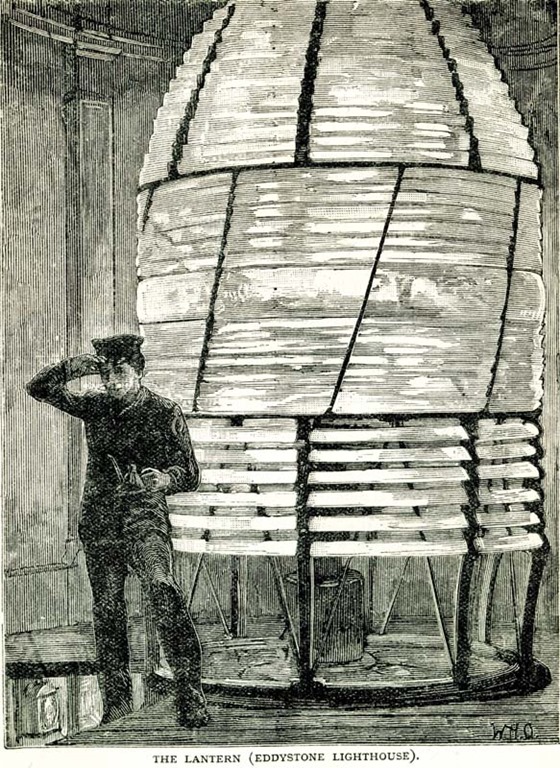
At the top of the tower rises the lantern – of strictly speaking, the lamp-room – about 10 feet high, whence the guiding light flashes forth over miles of sea.
The lantern is largely made of glass, like a hothouse; and splendid views you can gain through its glazed sides of miles of heaving seas. A blue expanse it appears this afternoon, flecked with white in the summer sunshine.
In the room itself glass and bright metal glint everywhere. It is domed with copper, and fitted with quarter-inch or half-inch plate glass ‘sides supported in diagonal astragals, or mouldings of gun-metal. These are so arranged that they do not intercept the light when it is required to beam forth.
In the centre rises the lighting apparatus and, at first sight, it seems something like a mound of prisms. What can be the reason for all these ribs of glass? The answer is that they help to condense the rays of light into one strong beam.
‘Why, I suppose our light here,’ says the lighthouse keeper, ‘can be seen for nearly 20 miles – 17 at least, and perhaps more.’
‘But I can’t see how these curious triangular ribs can accomplish that.’
‘Well, you must know – nearly everybody knows – how much a shining reflector behind a lamp intensifies its light in one direction. And the mirror is usually concave to bend the rays that radiate above and below more decidedly into one line. That is what these reflectors accomplish; only far, far more effectually. A parabolic reflector 20 inches or so across will increase the light-giving power of the lamp about 400 times, or even more.’
‘Then these prisms are to bend down the rays of light that would rise too high, and to bend up the rays of light that would sink too low?’
‘Exactly; we do not want to try and illuminate the sky and the sea; we want to send strong beams as far as we can round the horizon. A lighthouse is a guide, rather than an illuminator, like a street lamp.’
‘And why have you several reflectors group round like this?’
‘In order to send several beams of equal power all round the horizon, where these is sea. That arrangement gives what we call a fixed light. For a revolving light, if the reflectors be grouped on a frame, with only two or more faces as required, and the frame be caused to revolve, light and dark intervals are, of course, produced – for the light only shines through the faces. In a similar manner, by a suitable arrangement of the reflectors, a group-flashing light is produced – that is, a light giving two or three flashes and then a brief period of darkness. Light of different colours can also be shown.’
‘Ah, just so. It is by such means as these that lights are given their characteristic and distinguishing features.’
‘And, by nothing their number of flashes or other peculiarities, a sailor can tell what light it is and consequently determine, more or less, his position. Of course, we have a lens as well – even a policeman’s bull’s-eye lantern has a lens – and with the numerous wicks and large lamp-flame now used, and the big prisms bending above and below, there is not a ray of light that escapes.’
This system is called holophotal. The word means reflecting or refracting light without loss of light. Paraffin is the illuminant. ‘Nearly every sort of oil haws been used,’ says the lighthouse keeper, ‘but paraffin comes to the top. It burns brighter, and it is cheaper.’
Peering into the midst of the prisms to see the gigantic lamp itself, we distinguish not one wick but many – seven in fact, like concentric rings – one within the other. Some lights, indeed, have nine wicks; this multiplication of them, of course, greatly increasing the illuminating power. With these numerous wicks, the oil has to be supplied by clock-work pumps, or pushed by a heavy piston. An overflow pipe permits the paraffin to run back to the fountain should it at any time rise above a certain point.
The electric light has also been used with great success at various lighthouses; and for harbour lights, where gas may be readily obtained, that illuminant is sometimes employed. But at times even the most powerful illuminants are obscured by fog – what then?
Then this curious-looking trumpet comes into play. Terrible is the nose it makes. No human breath blows it. Gas engines are needed, and in some lighthouses oil engines and compressed air are used to evoke its ear-splitting but useful sound. When the day is dense with obscuring fog and even the light of a nine-wick lamp, focussed into a few powerful beams by many prisms, can struggle but a poor mile or two into the bewildering gloom, then this trumpet, called by strange irony a siren, will shriek forth its warning blasts.
There are two discs in the siren-trumpet, each disc a foot in diameter, and with a dozen radial slits. One disc is fixed but the other rotates rapidly, nearly 2000 times a minute. Sirens can be so arranged as to give signals, such as two or three blasts in rapid succession at certain intervals; and the passing sailors should then know the lighthouse, even as if they could see its characteristic light. The shriek of the siren can be heard sometimes for ten miles. Charges of detonating powder are also fired at some stations, electricity being used to explode the cartridges; so that when the light fails to piece the shrouding fog, the lighthouses still strive to perform their duty of guiding and warning, by means of thunderous sound. A little-known explosive called tonite is sometimes used for these warnings. Tonite appears to be a mixture of gun-cotton and nitrate of baryta forced into a cartridge like a candle.
‘And what are those panes?’ you ask; looking a frameworks of copper filled with glass.
‘Storm panes,’ is the answer; ‘they are kept in readiness should a pane of glass be broken in the lantern.’
‘And do you often have to use them?’
‘Very rarely; and then it is generally because birds or stones are blown against the lantern glass in a tremendous gale. It is very seldom that the wind alone breaks the glass. You see these gun-metal mouldings and thick plate glass panes are very strong.’
‘Do birds break the glass?’ exclaims some one in surprise.
‘They do so, and no mistake. You might be watching here some dark night and see scores of birds beating against the glass, and blown hard against it. Perhaps they are migrating to another country at the change of seasons, or perhaps they are coming to this land. Anyhow, there they are; likely enough they are tired out with their flight and attracted by the light, or knocked against the glass by the wind.’
What a different scene is thus conjured up, from the calm, bright summer sunshine of the lovely afternoon. But whatever the moods of weather – though tempests rage and torrents of rain lash the streaming glass; though the storm-tossed billows strike the house with thunderous sound, and dash the spray high up the sides; though the blasts seems to shake the massive tower with the fury of wind and wave; though choking fog encompass it around, or the calm moon rides in a cloudless sky – yet still in every change of changeful life this friendly beacon sends forth its warnings of light and sound.
Reproduced with permission of Aysgarth Parochial Church Council
From The Church Monthly in 1894: “Out with the Fire Brigade” by F M Holmes
 There is the alarm bell!
The startling clang rings through the room and a tablet has fallen on the wall, not far from your head, revealing the name of the London street whence the alarm was given.
Some one has broken the glass and pulled the handle of the fire-alarm post in that thoroughfare, and instantly all the arrangements of the station for proceeding to the fire are set in motion.
There are always men on duty, and more alarm bells ring with noise enough to wake the proverbial Seven Sleepers of Ephesus. A pair of horses are always in readiness, their noble heads, full of animation and expectancy, turned towards the stable door and the light harness hanging over them, ready to descend at a second’s notice, is dropped on their backs.
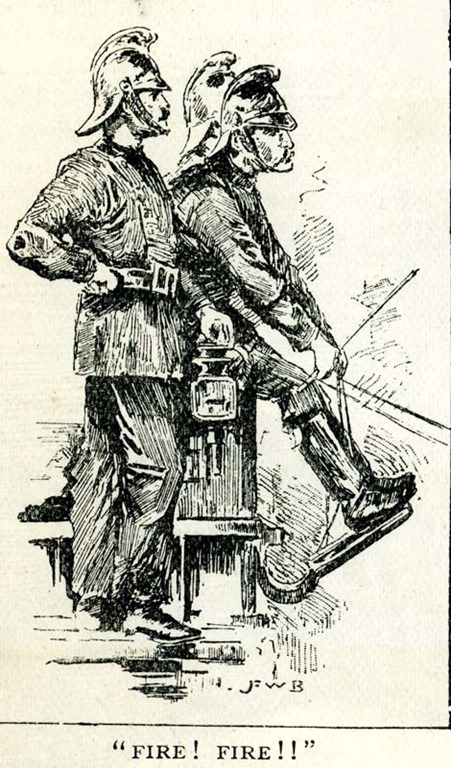
The intelligent creatures know the ring of the alarm bell as well as the men and are as eager to be off. The preparations are so complete that, when a rope is pulled, down falls the harness. Full of excitement, the steeds are led to the engine which, in its turn, is as fully prepared as are the horses. The traces are hooked on, the men jump to their seats, and with the startling cry of ‘Fire! Fire!’ screamed as only a London fireman can utter it, the engine tears out of the station and into the street. Less than two minutes has elapsed since the ringing of the alarm bell; and the engine is already on its way.
Most exciting is the rush through the streets. Quick movement through the air is usually exhilarating at any time and to this is added the excitement of the fire and the startling cries of the firemen. Everything scatters before us. Even the red carts of the Post Office – which may trespass on the thoroughfares reserved for royal processions – have to give place to the dashing Fire Brigade.
With steam hissing from the boiler, with horses all aglow with excitement, and with alarming cries of ‘Fire! Fire!’ ringing along the street, a pathway opens as if by magic through the most crowded thoroughfares; and almost before you know it you have arrived at the scene of the fire.
Here the excitement is no less; but the men are as cool as cucumbers. ‘Play on that part of the building’, comes the order, hardly sooner said than done. The engine, which a few minutes ago was quiet at the station, is now at vigorous work some miles distant from its home.
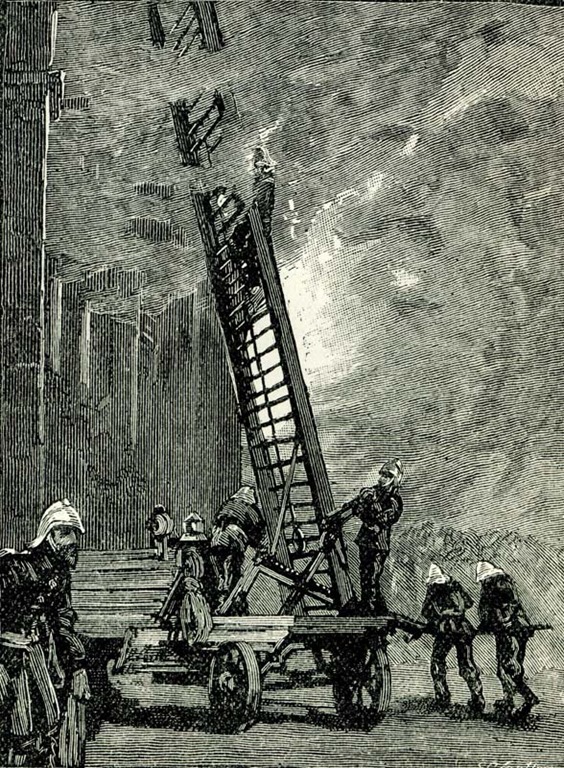 The flames burst out through the veil of smoke and leap upward to the sky. The gathering crowd press forward with excited faces and are, with difficulty, kept back by the few policemen on the spot. A cry raises: ‘Somebody is in the building!’ And here comes the fire-escape which will reach the highest windows. It is placed against the house and quickly a fireman mounts. See! he has rescued a mother and child, and he brings them down amid excited cheers. Sometimes he has a much harder task; for he enters the burning building and gropes amid the blinding smoke and scorching heat to rescue the half-suffocated sufferers from the flames.
Meantime, other engines have arrived. Each fulfils its part. While some are playing on the fire itself, others are drenching surrounding walls with water to prevent the fire from spreading; and ere long the officer in charge will be able to report that the fire is localised and mastered. Wise forethought, as well as smart promptitude on the part of the men, have contributed to these satisfactory results.
If you had inspected the engine you would have found everything ready for instant departure – the fire laid, axes, hose, and apparatus in position; but you would also have found two things which perhaps you would not expect. Under the boiler is placed a movable gas jet which keeps the water always hot; and by the funnel is large fusee [a large-headed match capable of staying alight in strong winds].
When the alarm sounds, one of the men on duty ignites the fusee at once – he knows exactly where to find it – and drops it down the chimney. The fusee is certain to flame well and lights the material below, already prepared to receive its fiery touch. The quick rush of the engine through the air does the rest; for the speed creates such a strong draught that the engine fire soon roars in its box, and raises the heated water to steam.
The steam in the fire-engine is used for pumping the water and throwing it on the burning building. But, successful as it is, the steam fire-engine has not superseded the use of manuals; while for small fires – of which there are a great number in the Metropolis – the little portable hand-pumps are said to be of the greatest value. These little pumps can be used anywhere, and taken into rooms where the fire may be burning. Speedily used they will, in ordinary circumstances, quickly extinguish the flames and prevent a little conflagration from becoming a big one. The water for their use is contained in a bucket which is supplied by other buckets of water handed up by assistants.
Valuable as these little pumps are for small fires, however, there is need, of course, for the glittering and powerful steam fire-engines for bigger fires; and of these ‘steamers’ the Brigade have fifty on land and about ten floating on the Thames. There are also a large number of manuals. Their wheels are broad and tired with wavy iron bands which project in some places beyond the sides of the wheels themselves.
Many persons, no doubt, would puzzle for hours over the reason for these strange iron tires; but the reason is simple. They are used to prevent the wheels from canting or tripping at the tram rails which seam so many London thoroughfares. It would be a bad accident, and a terrible hindrance at a critical time, for a fire-engine to be overturned when driven at a headlong pace to a fire. In the same way, should a horse fall when tearing along, the harness is so arranged that the turning of a swivel-bar at the end of the engine-pole dividing the two horses, will free the animal in front, and he can be unhooked and helped to his feet again in a trice.
The hose also is subjected to a most severe testing before being used. At a fire, the water is forced through the hose at a pressure of a 110 pounds to the square inch. For a hose to burst under this strain would be a great disaster. Consequently, every length is tested up to the severe strain of 300 pounds to the square inch, so that it is as certain as anything mortal can be to stand firm in actual work. The hose is now made of strong, India rubber-lined canvas which is light and flexible as well as tough and tenacious, and has quite superseded the old hose, made of pieces of leather and riveted together by metal fastenings. The hose for the suction-pipe, communicating with the water supply, is usually stiffened by spiral wire and is still very flexible.
A fire-engine, therefore, has to do two things: it has to draw large quantities of water from a suitable source of supply; and it has to throw that water, steadily and continuously, and sometimes to a great height, on to the fire. This is accomplished by means of force-pumps in the engine and an air-chamber. The pumps draw water through the suction tube from the water pipes under the street, or other suitable source of supply, and force the precious fluid into a strong air-chamber or chest, thereby compressing the air in that chest to a high degree. But, having pressed the air to a certain point, the air itself will, in its turn, become stronger than the fore-pumps, and exert pressure on the water, which it forces out through the host to the fire. It will continue to do this until the water sinks in the chest. So long, therefore, as the two pumps force water into the chest, up to or above the requisite level, so long will the compressed air expel the water to the fire in a steady and continuous stream. The two pumps are arranged to work reciprocally – that is, one is drawing water, while the other is forcing it into the air-chamber, each in its turn.
The rule is that a steamer shall go from one station and a manual from another station in the neighbourhood. Thus, the stations are not left without resources should another fire break out in the district. All the Metropolitan stations are connected by telegraphic or telephonic communications, so that the Headquarters at Southwark can be acquainted with all that occurs as regards fires in the Metropolis, and a large force concentrated speedily, if necessary, at any point. In addition to Headquarters there are five District Stations, each having a superintendent in control of the district, and having telephonic speech with Headquarters, and with each station in the district.
Being liable to be rung up in their sleep, firemen are, so to speak, kept constantly on duty, except for 24 hours in every 14 days which is their ‘day off’. Should, unfortunately, several fires occur about the same time in the same neighbourhood, the men may have to work for some 36 hours at a time. And, on returning from a fire, the hose has to be cleaned and scrubbed, and hung up in the hose-well to dry; the engines have to be kept in good order, and prepared for another journey at once should necessity arise.
Constant vigilance is the order of the day with the Fire Brigade; and to this is added elaborate preparation and daring bravery. Most of the outside public see only the headlong speed and feel the exciting thrill of the fateful moment; but behind and around that dashing ride lies the most careful fore-thought.
Reproduced with the permission of Aysgarth PCC.
Steam fire engines were in use from the 1840s until the 1920s.