From the Past
‘A Ride on a Railway Engine’, by F M Holmes, published in The Church Monthly 1894
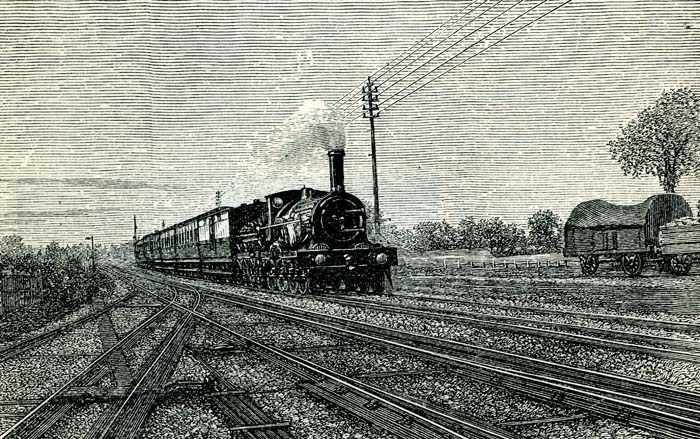
Above: ‘Flying Dutchman’ passing through Collumpton in the 1890s
‘Right away, Jem! There’s the whistle!’
Jem opens the throttle – that is, he turns on the steam – and the engine slowly to move.
Watch him, and you will see that he is lifting the handle of the ‘throttle’ gradually. If he turned on the full head of steam at once the probability is that, with the heavy weight of the train behind, the driving-wheels of the engine would fly round uselessly, and would not grip the rails at all.
Sometimes this does occur when the rails are greasy. Then the ever-ready hand of the driver closes the throttle for the moment and his equally ready fireman sends sand on to the rail through a pipe provided for the purpose.
But nothing happens like this today. And the engine gathering speed – as the steam is gradually increased and the heavy train acquires momentum – is soon flying along through the suburbs of the great city. Then, with a burst, we are into the open country.
The air rushes past so furiously that it seems like enough – as people say – to cut your ears off; and there is a jerking, shaking motion that seems as though it might throw you off your feet. You clutch at a steel rail near by convulsively to steady yourself.
How warm you are on one side as you stand here on the footplate of the engine and perforce near the hot furnace; and how chilly by comparison you are on the other; and how difficult amid this noise and racket to hear what your companions are saying.
‘Signals up!’ A wild shriek startles your ears as the engine whistle rises above the rush and roar of the train, but still the signal does not move. Then off goes the steam. The driver, standing with is hand on the throttle and his face to the window in front, sees there is no alternative, and turns the handle; and his fireman applies the brake.
There is a crippled motion of the wheels and the tremendous speed begins sensibly to slacken. Then suddenly down falls the signal and the line is clear. The watchful driver opens the throttle again, the brake is off, and once more we fly on along the railway at fifty or sixty miles an hour, the passengers behind scarce noticing, perhaps, that a check has been made. A signal against an express is very unusual; and that signalman will probably have to make an explanatory report to the authorities tomorrow as to the reason why his signal was at ‘Danger’.
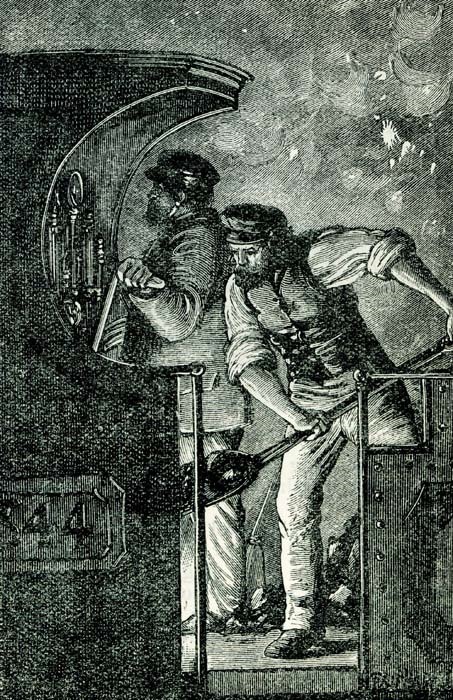
Then the fireman plies his shovel again. He is always doing it. The quantity of coal consumed by a railway engine would astonish the ordinary householder considerably. Perhaps the majority of people do not know that the waste steam, after doing its work, rushes up the chimney and thus creates an enormous draught, burning the fuel fast and raising the steam quickly. Yet this arrangement is, so to speak, the very life-blood of the locomotive, and is one of the most important principles utilised by Stephenson. The faster the engine tears along the more steam she raises – provided she have a sufficiency of coal and water. There is no need for a forced draught, as in some steamships.
The furnace filled up, the fireman seizes a moment for a drink of cold team. Then down comes smart shower of rain, and in a trice the thick pilot coats of the driver and his stoker are out and over their shoulders. But it does not last long; we soon drive through it and the sun is shining brightly again on the long lines of flashing metals that ever and ever stretch ahead.
You gain quite a different view when riding on an engine from when riding comfortably in a carriage. In the latter case you cannot look ahead. You gain views, more or less satisfactory, of the country beside you. But on an engine, through the windows of the ‘cab’ – as the screen and protection for the men is called on a locomotive – your eyes are drawn as by a spell to look forward. There is constantly before you the dry pathway cut by lines of gleaming steel and occasionally broken by a station. And indeed this is one of the most important parts of the driver’s duty, in order to watch the signals. With hand on the throttle handle and face to the window, he guides the flying engine over its iron road.
Then the gauges have to be watched – the steam gauge, which shows how much, or how little, is in the boiler. There seem to be handles all round you. This is the large lever which works the reversing gear of the engine and causes it to travel backwards. This handle admits water to the boiler; and this one blows off steam when the pressure is too great. Another works the brake; and a powerful vacuum or Westinghouse brake [air brake named after George Westinghouse who invented it in New York State in 1869] can be applied all along the train from the engine itself.
The power of these brakes is enormous. Fast expresses can be drawn up in splendid time by their commanding means. At the end of a large station platform the train seems flying along at its normal speed. But almost within its own length it is brought to a stand.
This great brake power is sometimes not without a comical side – to an observer. On one occasion, an engine driver was endeavouring to take out a long line of empty coaches from a certain metropolitan station. For some reason, which he could not understand, his engine would scarcely move. The steam was all right, his brakes were all right, yet the big train to which he was attached only crept along. At last he jumped from his engine and hurried to the guard’s van. With a roar he proclaimed the secret – the brake was ‘on’ there crippling all his efforts! In a moment, however, it was ‘off’ and he was soon down the line with his empty carriages.
The keen watchfulness of signals is one of the most important duties of enginemen. They pass hundreds in the course of the day and, according to the state of the signal, so have the men to act, or refrain from acting. That signal-arm we can see far along the line… that arm, growing larger as we quickly approach it, lowers to allow us to pass. We fly by at lightning speed and, in a second, it rises again to prohibit anything else from following us till we are far ahead and beyond the next block-space of line.
How fast can a train travel? It is not an easy question to answer. Probably the average rate of most English fast trains is about 45 miles an hour. But it must be remembered that in order to attain this average speed, including all stoppages and ‘pantings’ up heavy gradients, the train must sometimes run much faster. A mile a minute is often accomplished. Mr W. M. Acworth tells us that a Worsdell ‘compound’ engine once ran from Grant’s House to Berwick at 76 miles an hour for some miles in succession as indicated by the speed register on the engine. And the 2 p.m. Great Northern from Manchester, one of the fastest regular trains in the world, was reported in the Engineer to have rushed over short distances at the rate of 78 miles and 76 miles per hour from Grantham to London.
It is competition, no doubt, that has something to do with this quick running. By the Great Northern route Manchester is 203 miles from London, by the North Western 189 miles, and by the Midland 191 1/4 miles. In order, therefore, to compete successfully with the fast 4 1/4-hour expresses of the North Western, the Great Northern must run faster by about three miles an hour.
The kind of road over which the engine travels has a good deal to do with its speed. Up hill and down dale spoils the pace of engines as of horses; and a moderate average speed – on paper – over a hard road may be really better work than a sensationally high record along a flat valley. Then there is economical stoking to be considered. The drivers engaged on certain classes of work are, on one line at least, formed into a party or, as it is called, a ‘link’. All the coal and oil supplies to each engine is put down and the amount added up weekly and divided by the number of miles the engine has run. A notice showing how much each man has used is then exhibited, the most economical, combined with punctuality, being of course placed at top. The good stoker should, at the end of the engine’s work for the day or night show a clear fire burnt to the bars, but with undiminished steam pressure.
Enginemen know their engines like their alphabet and their roads like their native town. As each locomotive contains something like 5,000 separate pieces, this knowledge is not acquired in a day. Drivers have long and arduous preparation to plod through before they are promoted to the foot-plate of an express, and they have onerous work when they get there. But it is worthy of a man – a man with a good head on his shoulders and steady courage in his heart.
[Today we can say man or woman…]
reproduced with the permission of Aysgarth PCC.
‘A Night in a Herring Boat’ by the Rev A M Fosbrooke, then curate of Stoke-on-Trent
It was three o’clock in the afternoon when we started from Port Erin. There were eight of us on board, seven fishermen and myself. The dingy having been hauled up, and the sails hoisted, in a few moments the strong breeze blowing carried the Puffin out of the bay and westwards towards the Irish coast.
We had a mackerel-line out and, though the boat was going much too fast for satisfactory fishing, about half a dozen were caught before evening. The sky became dark and cloudy and, before long, the rain descended in torrents, so as to make one thankful for the oilskins, sea boots, and sou’-wester which a sailor had kindly lent. About 8pm the sky cleared and we were favoured with a beautiful sunset. The wind fell and practically no further progress could be made, so it was decided to ‘shoot’ the nets.
We were about mid-channel – the Manx coast on the one hand and the Mourne Mountains on the other being distinctly visible. A large number of puffins and other birds were flying about which made the men think they might have a successful night. The sails were lowered with the exception of a small jib; and as the boat slowly moved on by means of this one sail the net was cast out, it being connected at intervals to a strong rope called the ‘spring-back’, the same length as the net, the purpose of which will be explained in a moment. The two are connected together by one of the men as they are thrown out.
Let me try and explain the nature and position of the net as it lies in the water. On the surface there are large cock floats about every ten yards; from these hang down thin ropes, called the ‘straps’, about nine feet long, which are fastened to the spring-back. From this, again, hang thin ropes called the ‘legs’, about 12 feet long. These are fastened to the rope along the top of the net which is called the ‘back’, and the net itself, weighted at the bottom to keep it perpendicular, is about 30 feet deep; so that from the surface of the water to the top of the net is about 21 feet, to the bottom of the net 51 feet. The length of the net is about one mile or sometimes longer than that.
The object of having the net so far below the surface is partly, of course, as being more favourable for catching the fish, but also to enable any ship which might happen to cross the net to do so without causing any damage. Even still, a ship drawing a great deal of water such as our ironclads, will sometimes carry away their nets to the great loss of the fishermen.
The whole of the net having been ‘shot’ out, the large mast is lowered in order that the boat may not roll so much in a rough sea and also to prevent the wind catching her so much. A small sail at the stern keeps her steady with her head to the wind. A light is put up as a danger signal, one man stays on deck to keep watch, the rest retired for the night. And there the boat lies tossing aobut on the rolling waves, looking very much like a wreck, with her mast lying down and her ropes hanging loosely about.
Before we lay down to rest in the small cabin … an evening hymn was sung and prayer offered by one of the men, commending themselves and their loved ones to the care of our Heavenly Father and asking Him to ‘preserve to them the produce of the seas.’ This is an old time-honoured custom among the fishermen; it is still kept up on many of the boats, though not on all. It was rather a remarkable fact that all my seven companions that night were total abstainers. Nothing of an intoxicating nature is allowed on board the Puffin.
It was very hot and stuffy with seven of us in the small cabin, about three yards long by two yards wide, and a hot fire in the grate on an August evening! This heat and the rolling of the boat in a rough sea were very conducive to sea-sickness. I was not sorry when at 3am the day began to dawn and all hands were called on deck to haul in the net. This, of course, is the most interesting part of the proceedings.
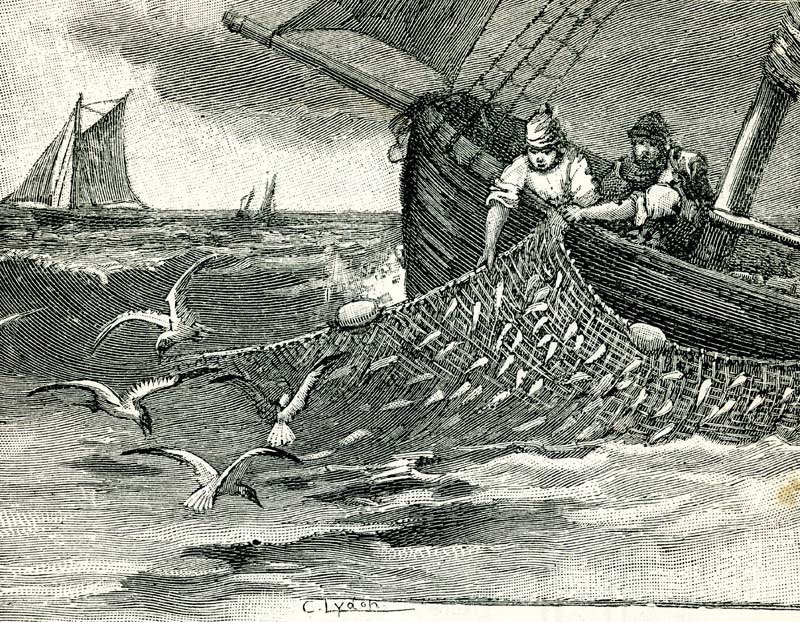
The net is no drawn in from the two ends, enclosing the fish, as many of us might suppose, but just hauled in from the one end in the following manner: Two men work at the winch, hauling in the spring-back. The boat is thus gradually drawn along by the weight of the net. Another man unfastens the cords connecting the spring-back to the net; two others haul in the net and set free the fish; one arranges the net in order in the hold as it comes in, another coils up the spring-back in another part of the hold; so that the seven men are really required for the work. The fish are caught by swimming into the net and getting fastened by their gills in its meshes. Then, as the net is hauled over the bulwarks, they are pulled off one by on or, if the catch is a large one, they are shaken off on to the deck by jerking the net.
Unfortunately, the fish seem to be leaving the Irish Sea; for the last four or five years only very few have been caught. Only 400 were taken on this occasion and many a night they do not take so many as that, whereas in the good days they could take as many as the boats could carry. They have sometimes been known to take as many as 100 ‘mease’ (a mease = five full hundreds of 120 each). One cannot help feeling great sympathy for the fishermen in the poverty and distress which seem to threaten them at present. The hauling of the net took over an hour. Then the mast of the boat was re-erected, the sails hoisted, and her bow turned towards home.We caught a few more mackerel with the trawling-line while returning.
Breakfast was prepared on board consisting of coffee, bread and butter, and a real fresh herring, which was most delicious. The sun rising over the Manx hills and lighting up the sky with very varied tints made a beautiful picture. A strong, favourable wind bore us on at a great speed and by 8am I was back again in Port Erin Bay after a very interesting and enjoyable experience.
transcribed from The Church Monthly annual 1894 with permission of Aysgarth Parochial Church Council.
- Lighthouses with Paraffin Lanterns in the 1890s
- Out with the Fire Brigade in 1894
- The Telegraph Messenger Boy in the 1890s
- Nightingale's duet
- Children's Playtime in early 1890s
- Churches Sprouting Trees!
- Rambles of a Naturalist in 1900
- Bouquets for Waifs and Strays
- Emigrating to Canada in 1892
- Memories of a Beetle Collector
- A Mothering Sunday Story
- The Doctor's Window