Pioneering Girls’ Education
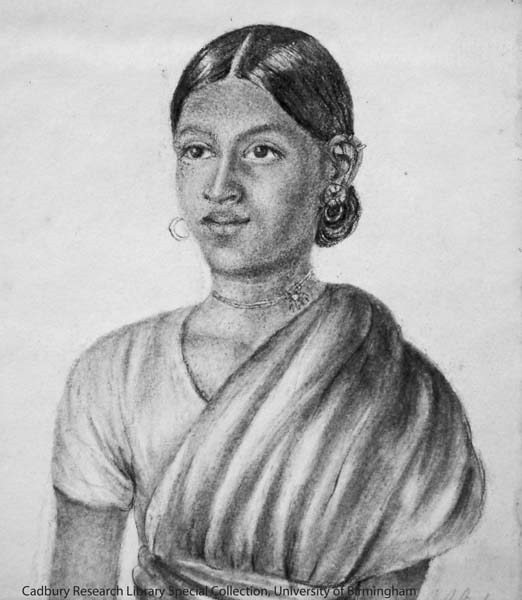
The album and journal of Caroline Cuffley Giberne (1803-1885) provides a fascinating insight into the development of female education in South India. She was the first to train South Indian women as teachers and one of those who graduated from her school in Kadatchapuram, near Palayamkottai in Tamil Nadu in the 1840s, was Mrs Anna Satthianadhan (daughter of the Rev John Devasagayam), who went on to set up several schools herself. Miss Giberne’s journal contains some of her often haunting sketches of her first students – like that of Anbye Lydia (below) who died just a few years after joining her school.
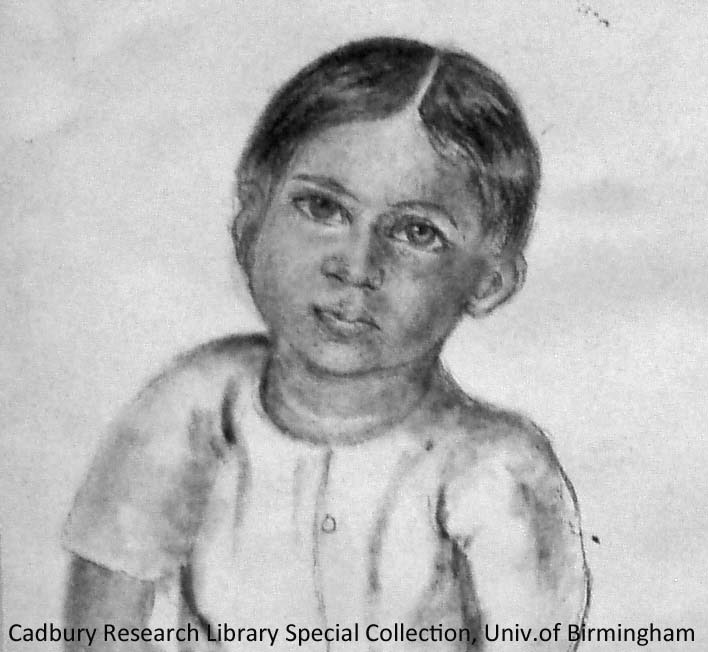
Miss Giberne would have watched girls like Anbye Lydia while sitting on her verandah in the cool of the evening and wondered whether she could make a success of that small rural teacher training school in Tirunelveli (Tinnevelly) District. In 1845 she certainly could not have imagined that one of her “undisciplined” school girls (Anna Satthianadhan ) would ever have the honour of being introduced to Queen Victoria!
She was far from impressed with her first group of students even though she had selected them herself. The objective of the Normal School she had set up in 1843 was to train female Indian teachers 1 but to her it was more like a dame school in England than a good “lady’s establishment”.
In her journal 2 in April 1845 she wrote: “There is something about them which I do not like. They are close and not at all open characters but remind me of common English schoolgirls, whispering together, while before me they are as silent as possible. This is my present interpretation of them, but they may improve.” She added that the girls were not used to submitting to the will of others and so were rather unruly. “In time they will I hope be in good order.”
One of the biggest problems was that the girls had only ever learned by rote. “They cannot think!” she complained.
To add to her problems the Indian parents, even the Christians, were very wary about sending their daughters to a boarding school which was not within easy walking distance from their homes. And few were convinced about the need to educate their girls.
In the late 18th century the first Christian missionaries to South India, like the Rev Christian F Schwartz 3 had encouraged the Christian converts to open schools for boys. Martha Mault is accredited with opening the first boarding school for girls in 1821 4. Her husband, Charles, was sent to Nagercoil in what is now Tamil Nadu State by the London Missionary Society and it was there that his wife began the family’s involvement with female education in India.
Other missionary wives followed her example including those associated with the Church Missionary Society (CMS). It was at Palayamkottai near Tirunelveli in 1836 that the wife of CMS missionary, the Rev Charles Blackman, gained her first experience of teaching Indian girls. When they moved about 30 kilometres south east to Sathankulam Mrs Blackman decided to experiment with day schools and the first was at Kadatchapuram in September 18375 5 This was one of the earliest villages created by the Native Philanthropic Society as refuges from violence and persecution for those who had been converted to Christianity 6.
At Kadatchapuram Mrs Blackman was able to employ a school master and a school mistress. The latter was a married woman whose father, a Christian Catechist, was undaunted by the prejudice against female education and had allowed his daughter to attend a boys’ school 5.
The Blackmans left India in December 1841 and some of the school mistresses wrote to remind her how parents and others had long resisted the idea of female education stating that “it is not good or proper for girls to learn to read.” The school mistresses added: “Thus for a long time they kept up the bad practice of thinking meanly of us, the female sex, and reared us like young wild beasts.” 7
The Rev John Devasagayam and his wife took over the supervision of the girls’ schools started by Mrs Blackman 8 and had encouraged the formation of the Normal School. The Rev Devasagayam came from a Christian family and had studied with the Rev Schwartz. He was the second Indian to be ordained as an Anglican minister and the first national to become a Church Missionary (CMS) district missionary 9.
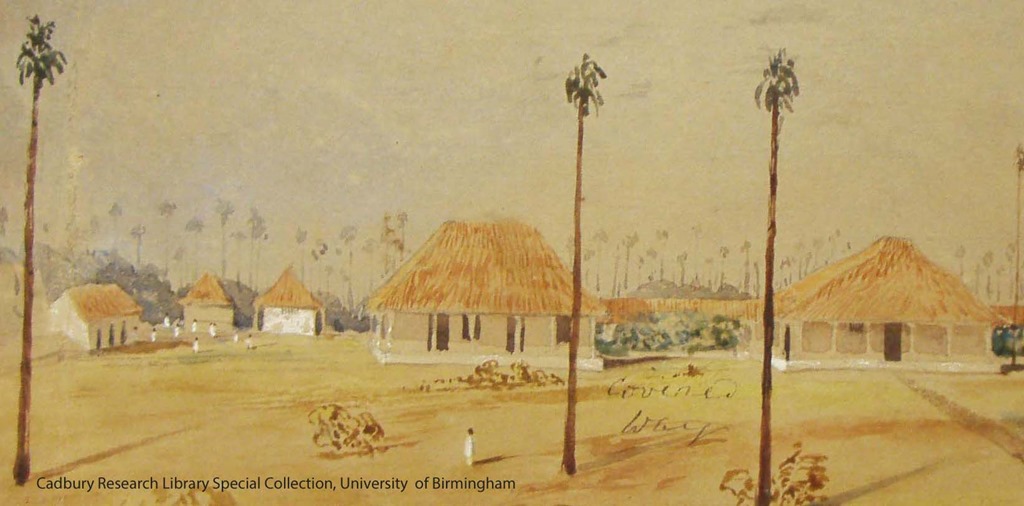
Miss Giberne’s first home in Kadatchapuram was a “native” bungalow owned by the Rev Devasagayam and his wife. They sent their own daughter, Annal Arokiam (“child of grace”) to the new Normal School and to Miss Giberne she became Anna (later Mrs Satthianadhan ) .
Below – in the centre is the bungalow built for Miss Giberne at Kadatchapuram.
Through the support of the Rev Devasagayam Miss Giberne had finally been able to fulfil her calling. She was 35-years-old when she arrived in Sir Lanka (Ceylon) in 1838 believing that she was about to begin what she saw as her life’s work overseas. That had only been possible thanks to the Society for Promoting Female Education in the East (SPFEE) and its pioneering attitude towards single women. But the SPFEE had the policy that its agents should become self-supporting as quickly as possible by superintending fee paying boarding schools.
For Miss Giberne this meant supervising a school for Eurasian Burgher girls. These belonged to an economically and socially upwardly mobile group which valued an English education as a means of being accepted by the British colonial administration. Miss Giberne later lamented: “I had been greatly disappointed in Ceylon, at having seen so little of missionary operations.”
It was very unusual at that time for a single woman who did not have a father or a brother on the mission field to be employed by a missionary society but Miss Giberne was recruited by the CMS and moved to Tamil Nadu. She commented: “I arrived in South India with all the joyful anticipation with which I had left home more than four years before – and my expectations were not in the least disappointed.” After studying Tamil at Palayamkottai she went to Kadatchapuram where she chose 12 pupils, aged from six to 16 years, from the local day school. They slept on her verandah until the new school was built.
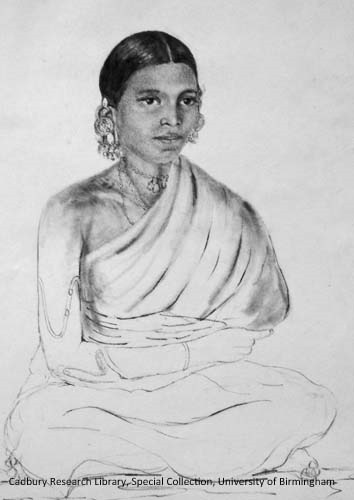
Her first senior school mistress was Nulla Mootoo (above) who had been a pupil at a school founded by Mrs Blackman. Nulla Mootoo moved to another village in 1847 and was replaced by Annamy. The latter had begged to attend the boarding school in 1845, was married in 1846, and took over as head teacher at the Normal School in December 1847. “She is a tolerable teacher but would be much more efficient had she been accustomed to discipline in her youth,” commented Miss Giberne.
She also wrote: “No one must imagine that our Indian women have attained anything in mental or moral requirements to be compared with Europeans, indeed it will be many years before they become such as we could wish, because our female teachers are few in number and have not yet arrived at that degree of perfection that is absolutely necessary for teaching the young.”
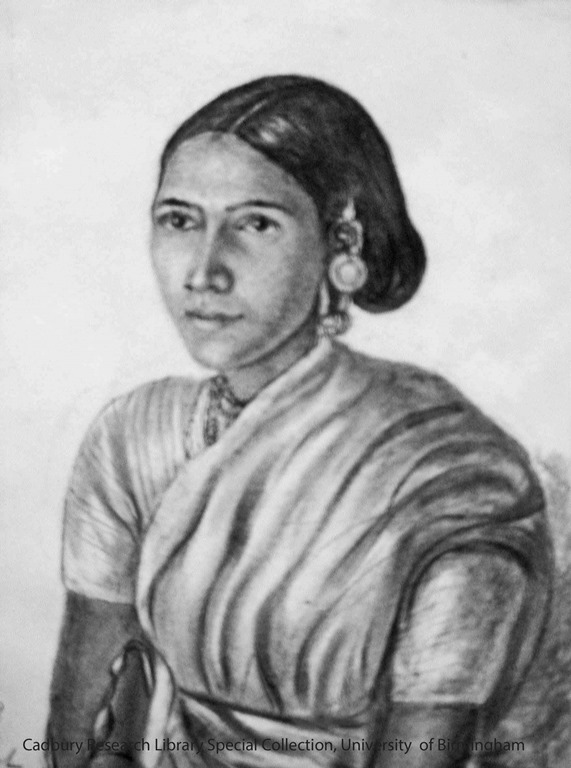
The first girl she trained to become a teacher was probably Sarah (above), who was 15-years-old when she joined the Normal School. Sarah got off to a bad start because her mother insisted that she should return home soon afterwards. Sarah, however, was so determined to attend school that she went on hunger strike until she was allowed to return. Miss Giberne took her back on the condition that she was not again “interfered with”.
But after a few months her mother again wanted to remove her from the school as the family planned to marry her to a young merchant. Miss Giberne reported: “As he was not well educated, I persuaded her to leave her daughter at the school and the young man to go and study (with) a missionary. As soon as she (Sarah) was prepared to teach I gave her a class of very young children and thus laid the foundation of an infant school.”
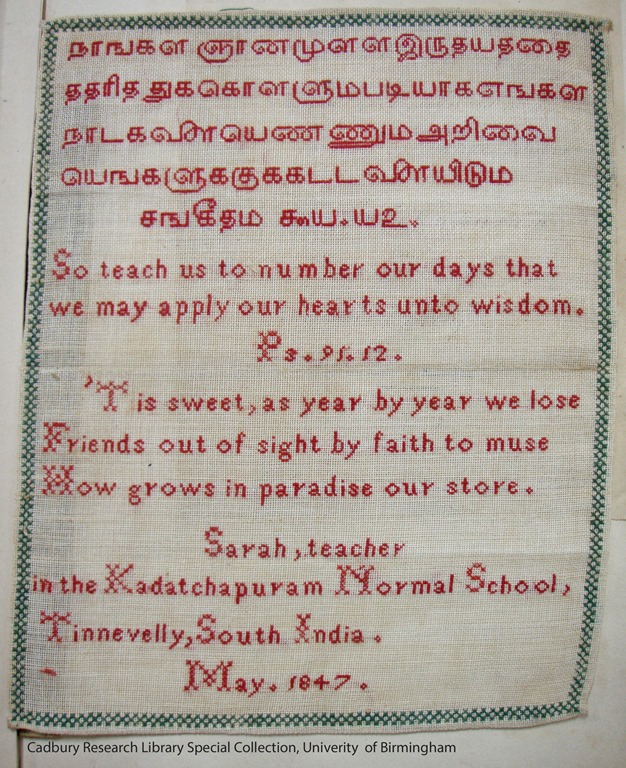
When Sarah did get married in July 1847 the couple were provided with a house next to the school.
Miss Giberne’s school was probably not so different to those started by Mrs Blackman, and it was also supported by the fund raising efforts of Sarah Tucker. Miss Tucker’s brother, the Rev John Tucker, was a CMS missionary in South India from 1833 to 1847. He started a girls’ school in 1845 and his sister, although disabled, became a firm supporter of such schools. 10
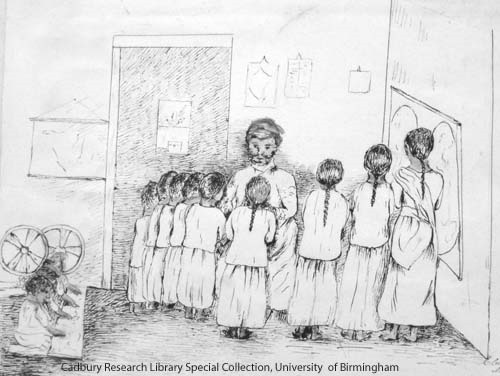
In her book South India Missionary Sketches Miss Tucker described the rooms as being spacious and lofty with no chimneys and no glass in the windows. There were just mats on the floor which she said gave at first a cheerless and unfurnished appearance. She added: “These things are, however, well suited to the climate; and so are the wide verandahs round the house, into which the rooms all open, and the outside blinds, called tats, made of the sweet-scented cuscus grass, which during the hot winds are placed against the verandah or the window, and having water constantly thrown upon them from without, cool and perfume the wind as it passes through 11.” (Below: Miss Giberne’s sketch of a school master teaching older girls while the younger ones practised their writing on sand covered boards.)
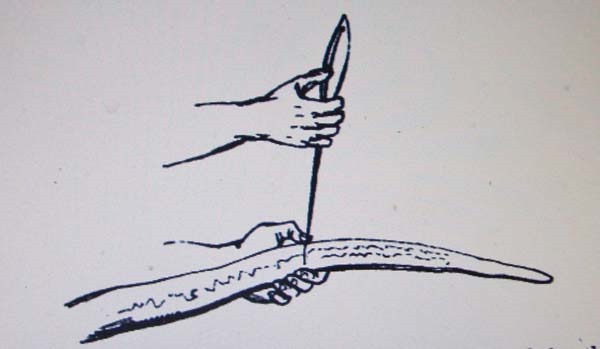
Miss Tucker was fascinated by the way that Tamils wrote at that time and stated: “You would wonder to see them write their copies, for, instead of paper, they have each of them an olei, or long strip of the Palmyra leaf, about an inch and a half broad, and one or two feet long. This they hold in the left hand, and in their right, instead of pen and ink, they grasp a style, or sharp iron instrument, which they rest against a notch in the left thumb nail, and with it scratch the words on the leaf. They afterwards rub it over with powdered charcoal, or the leaf of some particular plant, which, sinking into the scratches, makes the letters black or green.”
She said that school books were made the same way except that the strips were shorter and all cut to the same length and breadth. “They are kept together by a string fastened to a shell, which is long enough to allow the leaves to be sufficiently separated to be read, and when they are not in use, is twisted round them. Sometimes the outside leaves are ornamented with various devices, and when nicely executed, the whole is remarkably neat and pretty 12.”
Miss Giberne wanted the girls at her school to have copies of the Tamil Prayer Book but found it was too expensive to buy them. Instead the girls made copies on Palmyra leaves. Below: An illustration of writing on Palmyra leaf (olei) from Sarah Tucker’s book;
In 1847 she wrote in her journal: “When I look back a few years, to the time when the Normal School was first established and recollect the unruly girls of 15 or 16 years of age, whom I had then to break in, and see around me now, well-behaved girls of the same age, setting the younger ones an example of neatness, obedience, diligence, and order to which their teachers have scarcely attained, I am both surprised and thankful and can only say ‘What hath God wrought’.”
And when the infants were examined that December it was reported: “many …appeared to be sharp, intelligent children and answered very nicely. There cannot be a doubt as to the feasibility of establishing infant schools among our Christian people in Tinnevelly… provided we had a sufficient number of native teachers working under European supervision.” It was also noted that Miss Giberne had laid the foundation for a greatly improved system of female education at her Normal School.
In June 1848, when there were 26 in the Normal School and 35 in the infant section, Miss Giberne was advised by a doctor to go to England for a rest. She returned to India in late 1852 to spend another ten years in Kadatchapuram.
Four years before she finally retired to England the Sarah Tucker Training School for Women was opened in Palayamkottai. One of Miss Giberne’s pupils, Thungamuthus went on to become both a matron and a school mistress at that school. In a letter in 1884 Thungamuthus recalled how Miss Giberne had come to her village in 1843 and asked her father, the CMS Catechist Gnanamuttu, if he would send both her and her sister to the new school. By 1884 she was a mother and a grandmother and yet she finished her letter to Miss Giberne by stating “I remain, Respected and dear mother, your most obedient daughter.”
Miss Giberne carefully kept other letters from her graduates including those from Anna and her husband, the Rev W T Satthianadhan. In one of his letters he referred to Miss Giberne as “my mother in Christ”.
The Satthianadhans obviously forged a deep and long lasting friendship with Miss Giberne during her last ten years at Kadatchapuram. And Anna would go on to prove, with her husband’s support, that Indian teachers did not always need European supervision.
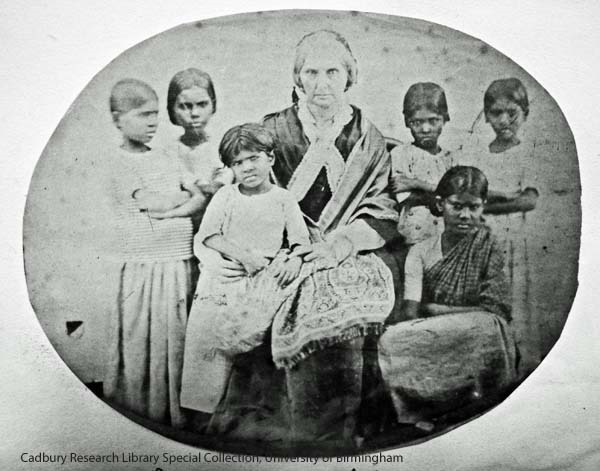
Below: Miss Giberne with some of her students.
©P Pointon November 2013
Sources:
- On its website (http://johnbaptistchurch.webs.com/historyofchurch.htm) St john the Baptist church at Kadatchapuram states that “Miss Kibern” established the first Teacher Training Institute for girls in 1843. The term Normal School for the system of training elementary-school teachers comes from école normale in the 16th century in France. The objective of these schools (and that of Miss Giberne) was to teach model teaching practices, with the teachers in the same building as the students (Wikipedia).
- With many thanks to the staff at the Cadbury Research Library Special Collection, University of Birmingham, for their assistance, and for access to the journal and album of Caroline Cuffley Giberne. These with the letters she kept with them were presented to Selly Oak Colleges library in 1950 by Miss Giberne’s great niece, Helen Neave, and were subsequently deposited in the Cadbury Research Library Special Collection. All the illustrations reproduced here are from Miss Giberne’s album and the rights are held by the Cadbury Research Library Special Collection.
- Christian Friedrich Schwartz (1726-1798), Lutheran missionary who was in South India from 1750 until his death in 1798. http://www.bu.edu/missiology/missionary-biography/r-s/schwartz-christian-friedrich-1726-1798
- Martha (nee Mead, 1794-1870) and Charles Mault (1791-1858) in South India – see David Gore’s post at http://www.britishempire.co.uk/article/faithandfamily.htm
- Sarah Tucker, South India Missionary Sketches, James Nisbet and Co, London, 1848 (3rd edition) Vol II pp134,145. http://www.archive.org/details/southindiansket00unkngoog
- Ibid Vol II p90 See also Dyron B Daughrity, A Brief History of Missions in Tirunelveli, International Association of Mission Studies, Port Dickson, Malaysia, 2004, p72 http://www.biblicalstudies.org.uk/pdf/ijt/46_067.pdf
- Ibid Vol II p147
- Ibid Vol II p149
- CMS Missionary Register List III, Native Clergy, no 2, died at Kadachapuram in January 1864, aged 78. Ordained as a deacon in 1830 and as a priest in 1836; See also http://johnbaptistchurch.webs.com/historyofchurch.htm ; and Eugene Stock, Beginnings in India, Central Board of Missions and SPCK, London, 1917 – Project Canterbury ://anglicanhistory.org/india/stock_beginnings/06.html
- Rev John Tucker (d 1873) http://www.mundus.ac.uk/cats/44/1211.htm; and see the School page on http://pvbungalow.com/. Concerning Sarah Tucker see http://www.sarahtuckercollege.in and Daughrity p81, footnote 79. For the development of mission schools and colleges in Palayamkottai see Daughrity p 75. On the Sarah Tucker College website it states that it “holds pride of place as the first college for women in South India”. According to Wikipedia Palayamkottai is known as the “Oxford of south India” and most of the schools were founded by Christian missionaries in the 19th century.
- South India Missionary Sketches, Vol I p9
- South India Missionary Sketches , Vol 1 pp76-77, including illustration of olei.
Both Anna Satthianadhan and her husband, the Rev W T Satthianadhan, were honoured when they were presented to Queen Victoria in 1878 – Anna for her work in female education and her husband for pioneering self supporting and self governing churches in South India. By then Anna had proved that her old mentor, Caroline Cuffley Giberne, had been wrong to believe that Indian female teachers would require European supervision to be successful.
Queen Victoria also read the novels of Krupabai Satthianadhan, Anna's daughter in law. Krupabai's second book Saguna was the first autobiographical novel in English to be written by an Indian woman.
At the CMS anniversary meetings in 1878 it was reported that Anna’s husband was in charge of an important pastorate in Madras (Chennai). This was at Chintadripet which he renamed the Zion Church 1. He went on to take charge of the Southern Pastorate in Madras as well as becoming the chairman of the Madras Native Church Council 2.
Anna in 1878 was superintending six schools in four different suburbs of Madras with a total of 430 students. Four of these schools were for higher caste Hindu girls and the other two for those from “poorer classes”. In addition she was supervising the classes for 106 young women from upper class Hindu families (including Brahmins) in 56 zenanas. She was supported in this by the Church Missionary Society (CMS), the Society for Promoting Female Education in the East (SPFEE) and the Hindu Female Instruction Society. Lord Shaftesbury signed the Bible which he presented to her on behalf of the SPFEE as a memorial to her first visit to England 3.
From Miss Giberne Anna had learnt not only how to write well in English but also how to run a good school. And Miss Giberne was one of her role models in how to live a deeply committed Christian life sustained by a personal faith in Jesus Christ. Her other role models were her parents, the Rev John Devasagayam and Muthammal, and her husband. Unlike her he had been forced to decide between his family or Jesus. Below:Miss Giberne’s sketch of Anna when she was 11-years-old.
At the CMS anniversary meetings 3 he described how, when he was 14-years-old, his high-caste father had sent him to the mission school at Palayamkottai to learn English.
But the main study book was the Bible. This made him angry and one day he instigated a rebellion, and told the teacher that if this did not stop they would leave. The teacher, a blind man called William Cruikshank 4, called their bluff by stating: “You may all leave the school but give up the Bible I never will.”
So Satthianadhan continued studying there for another three years and recounted: “In the meantime the teacher paid particular attention to the inculcation of Scripture truths and applied them to the hearts and consciences of his students in such a way that they were much impressed by them.” He said that under this admirable teacher the “folly of heathenism” and the “truth of Christianity” dawned upon him.
He knew that to convert to Christianity would mean social alienation from his home and his community but finally he made that decision. The conversion of a higher-caste youth created a sensation in the district and emptied the mission school. He became an object of persecution and was dragged before two magistrates, European and Indian. But he was determined to continue as a Christian and was baptised with the names of William Thomas in 1847.
He began training for the Anglican ministry and worked with the Rev Devasagayam. He married Anna in 1849 and by 1855, when he went to Doveton College in Madras to complete his studies, they had two daughters, Joanna and Catherine (Kate). After two years of study he gained a gold medal for his examination results. The CMS then sent him to join an evangelistic itinerancy team in North Tirunelveli where the couple became very involved with a Pentecostal revival among schoolgirls in mission schools 5
In June 1859 he wrote to Miss Giberne at Kadatchapuram to share the special news that not only had his first son (John) been born but that his youngest brother had become a Christian 3.
After Miss Giberne had retired to England Anna wrote to her (in May 1863): “You will be surprized to hear that we are now in Madras. Although we did not like to leave our dear people at North Tinnevelly (Tirunelveli) yet we could not but submit to the leadings of Providence.” Her husband, who had been ordained as an Anglican priest in December 1862, had been assigned to care for two churches – one at John Pereira’s (Trinity Chapel), and that at Chintadripet. Once in Chennai his wife began a small school for higher caste girls 3.
This was something she could do as she came from a higher caste family herself unlike the majority of Indian Christians. Even foreign women did not have easy access to higher caste women. Irene Barnes wrote in 1897: “If a missionary should come in, she would take a look round at the door of the courtyard, and should the ladies be engaged in any occupation connected with the meals of the household she would go to another house, knowing her presence would be unwelcome, as the touch or shadow of a Christian would make the Hindu woman ceremonially unclean, and would necessitate a bath and washing of her sari before she could take her food.” 6
Satthianadhan fervently supported his wife and obviously encouraged her to follow the same pattern of education as his mentor, William Cruikshank. For the curriculum included reciting texts from the Bible from memory as well as Scripture history, reading, Indian geography, and studying the works of an Indian minor poet, Attihicudi.
In a printed leaflet to advertise her school it was stated: “All these girls began their alphabet here, and the little knowledge of these elementary subjects, they owe entirely to this school. They all belong to the middle classes, chiefly dealers and merchants, who form the bulk of the population in this part of Black Town.”
The girls were especially keen to learn needlework which they did each afternoon. Anna told Miss Giberne: “My object in opening this school is two -fold not merely that I may have a few caste girls under instruction but more especially that I may eventually attempt what is called zenana visitation. I hope that by God’s blessing on our labour I may have access to the homes of these little girls. Some of their female relatives already visit me and I am endeavouring by every means to gain their confidence. … It is my earnest prayer that the school will prosper and become fruitful. This is perhaps the first school for caste girls in connexion with our Society in South India and I heartily wish that it would not prove a failure.”
And her husband wrote: “I hope you will try to interest some of your good friends (in) my wife’s work here. It is a very important one. She is willing to devote her time and talents to God’s work and what she needs is pecuniary aid.”
Years later he reported: “There were no zenana missionaries, and her work was exceedingly difficult. ‘What caste are you?” – the Christians being always considered pariahs, and of the lowest caste. Mrs Satthianadhan being of good caste was welcomed, and by degrees was able to introduce first a little book written by herself called The Good Mother, on the management of children, and then other books, thus leading on to the Bible. In the first year only three families were visited.”
In The Good Mother Anna wrote: “The greatest blessing is that children sit at the feet of Jesus Christ, gain education and lead a life worthy of everyone. Instead of making them wealthy it is better to make them wise. Because the power of wisdom is the greatest thing to achieve.” She argued for a good loving balance between discipline and allowing too much liberty and warned parents that children learnt more by observation than by listening. 7
The Satthianadhan’s were very aware how much they depended upon the support of foreigners to keep the school going in those early days. Besides the funding they received from the CMS and via the Rev John Tucker, there were also donations sent by Miss Giberne and her friends which paid for presents for the pupils. Anna commented in 1886: “When (my) private school.. was first started, the pupils had to be induced to attend school regularly by means of small presents. Later, on when the system of school fees was introduced, and in some measure enforced, disastrous results followed, in the withdrawal of many children and few fresh admissions.”8
She also stated: “About thirty years ago the subject of Female Education was one which evoked little or no sympathy on the part of the native community at large. Indeed it could hardly have been introduced even into advanced circles without hostile criticism or incisive sarcasm.” The income from fees at her six schools had risen from Rs 10 in 1870 when they were first levied to Rs 721. In addition there was a total of Rs 1,653 in grants from the government as 173 pupils had passed the government examinations. This compared to Rs 680 received in 1876, the first year in which her schools were placed under government inspection. 8
From 1876 they had to follow the government curriculum which included reading, writing, arithmetic, poetry, grammar, geography and needlework8. But to her and her husband one of the main subjects had to be the Christian Scriptures. She stated:
“Few will deny that education without the wholesome restraints of revealed religion, especially at a period when atheism and infidelity, the product of the so-called modern philosophy and free thought , are so rampant, must be fraught with danger. ‘Knowledge is power’, but if imparted without a religious basis, or the recognition of the Supreme Being and human responsibility, it is likely to do more harm than good. The development of intellect, the formation of character, the training of the mind for the duties of life, and the attainment of the high end for which humanity has been destined, all seem to hinge upon the combination of education with religion. Our aim is therefore to place the historical facts and elementary truths of Scripture before the minds of the young, so that they may have opportunities of comparing them with their own religion, and when they attain to years of maturity to follow whatever their conscience and reason may dictate as right.” 9
The missionaries and Mrs Satthianadhan were so successful in altering attitudes towards female education in India that by the 1880s they were facing strong competition from Westerners and Indians who were starting girls schools and zenana classes with secular curriculums.
Anna trained Biblewomen so that they could visit zenanas to teach in Tamil, Telugu and English and explained: “With the elementary instruction in reading, writing, arithmetic and needlework the study of God’s Word is invariably combined,” 10 By the 1880s all of the female teachers in her schools had been trained in the Normal (teacher training) Class at one of them. But earlier she had employed both Christians and non-Christians, including a Muslim woman. She was also assisted by her daughters especially Kate (Mrs Hensman) and Annie (who married the Rev W.D.Clarke).
Some Hindus were converted but certainly not as many as the Satthianadhans would have wished. But many Indian women, including those hidden inside zenanas, benefitted significantly by this access to education – none more so than widows. Many were left virtually destitute and as social outcasts after their husbands died because it was believed (as even now 11) that they were responsible for those deaths. In 1890 a Hindu woman visited Anna and told her: “Years ago, you may remember seeing me as a little girl…and asking my mother to send me to some Mission School close by. My mother took up the idea at once, and sent me to the London Mission School.” She later became the headmistress of a Hindu girls’ school. This meant that when her husband died leaving her with two young children she could continue to earn a living. But she wanted to escape the social death of Hindu widowhood by becoming a Christian 12.
It is probably from two of Anna’s daughters-in-law that a clearer picture can be gained of Anna’s legacy and that of Miss Giberne.
When the Satthianadhan’s second son, Samuel, returned from England in 1881, with an honours degree from Cambridge University 13, he was fascinated by a young woman who was boarding with his parents. She was Krupabai, the brilliant daughter of Haripunt Khisty (a Brahmin convert) and was the first woman to study medicine at Madras Medical College. She had written: “I had chafed under the restraints and the ties which formed the common lot of women… How hard it seemed to my mind that marriage should be the goal of woman’s ambition, and that she should spend her days in the light trifles of a home life; live to dress, to look pretty, and never know the joy of independence and intellectual work. The thought had been galling. It made me avoid men.” 14
But in Anna’s son she found a man who would encourage her to achieve intellectual fulfilment. Ill health having stopped her completing her studies she married Samuel and went with him to Ootacamund where he was the headmaster of a school. She became involved in female education and set up a small school for Muslim girls.15 Despite often being ill she wrote poems, travelogues, prose and two novels. Saguna (serialised 1887 and 1888 in the Madras Christian College Magazine) was the first autobiographical novel in English to be written by an Indian woman. She completed her second novel Kamala after being diagnosed with incurable tuberculosis.
Krupabai grew up in a family where her father and eldest brother were committed Christians but her mother, although a convert, remained very much a Hindu. And so in Kamala Krupabai was able to describe graphically from the viewpoint of a Hindu how a child-bride suffered in a home dominated by her mother-in-law. She wrote: “What man with any self-respect would make much of his wife, give her learning, and raise her up to his own level? The wife, as the saying went, was the ‘cat under the plate’, the slave of the family and of her lord.” And added later: “She was his wife, his property, and he felt that there was no need for him to exert himself to draw her nearer to himself.” 16 In Krupabai’s story Kamala chose after her husband died to remain a Hindu and became involved in charitable work.
Eleanor Jackson has noted that it is possible to see Kamala as a Dickens type exposure of social conditions, an indictment of Brahmanical culture and caste and a lament for unfulfilled lives 17. Others may find Krupabai’s book too close to Christian missionary narratives in the 19th century which had helped to motivate people like Miss Giberne. The SPFEE for instance stated in the 1830s and 1840s that the condition of women in India, China and Africa was that of extreme degradation and wretchedness and added that a wife in such places “is cut off from all the sweet endearments of family intercourse, put down from her proper position as the friend, the counsellor, and the comforter of man, to a situation the most abject and humiliating: her treatment is the most cruel and revolting, and her mind, excluded from all intellectual enjoyment and all that is consoling and elevating, is left to sink into the utmost depths of sin and misery.” 18
It was not surprising that Queen Victoria and many missionary agencies in Britain were so encouraged and inspired by the Satthiandhans for they would have epitomised the empowerment that the Christian gospel and education could bring. Queen Victoria, after receiving a copy of Saguna, asked to be sent any other books that Krupabai had written 19.
Krupabai died, aged 32, in 1894 20, four years after her beloved mother-in-law, and two years after the death of her father-in-law. A few years later Samuel fell in love with and married another well-educated young woman – the first woman in South India to complete her graduation (from Presidency College in Madras, 1898). According to Subbiah Muthiah she was Hannah Ratnam Krishnamma but Samuel called her Kamala. She too was a writer and in July 1901 founded India’s first women’s monthly periodical called The Indian Ladies Magazine. 21
In her first editorial she wrote: “The main object of the magazine will be to help advance the cause of the women of India… The main influences that are at work in this land, have not appreciably affected the women, the men having benefitted more largely than the women in the matter of education and social development. If the people of India are to advance, they should realise that: ‘the woman’s cause is man’s; they rise or sink together.’” 22
A fitting epitaph to the work of not only Anna Satthianadhan but also Caroline Giberne’s!
©P Pointon November 2013
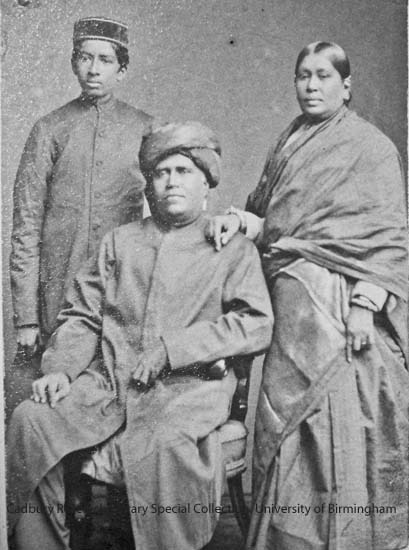
Below: A photo from Miss Giberne’s album which is undated. Miss Giberne simply stated that it was of the Rev Satthianadhan, his wife and son. She added that his wife, Anna, was the daughter of the Rev John Devasagayam commonly called “Mr John”.
Sources and notes:
- The Rev W T Satthianadhan (1830-1892) pastored the Zion church for 30 years, followed by his son-in-law the Rev W D Clarke, and then his grandson, the Rev Samuel Thomas Satthianadhan Clarke. This led to three generations of the family serving that church for 81 years up to 1944. The Rev S T S Clarke’s son ministered there in the early 1970s and then from 1974 to 1989 was the Rt Rev Dr Sundar Clarke, Bishop of Madras. Samuel Satthianadhan (1860-1906) became Chair of Logic and Moral Philosophy at Presidency College, Madras. Through Anna Satthianadhan (1832-1890) the family is descended from the first protestant Indian pastor, the Rev S Aaron, who was ordained in December 1733 by the Lutheran missionary Bartholomaeus Ziegenbalg. Most of this information is from S Mutthiah’s Madras Miscellany 2002.
- CMS Register of Missionaries and Native Clergy 1804-1904. In 1884 Satthianadhan was elected Fellow of University of Madras and in 1885 received a Bachelor of Divinity degree from the Archbishop of Canterbury.
- Throughout this post there are references to and information from newspaper cuttings and letters kept by Caroline C Giberne in her Album, which is in the Special Collection at the Cadbury Research Library at the University of Birmingham. The sketch of Anna at 11-years-old and the photograph of her with her husband and a son are from that album, and the rights belong to the Cadbury Research Library Special Collection.
-
For more about William Cruickshank see
http://www.independentliving.org/files/miles201104Pioneer-Teach-Blind_v2.pdf
5. Eleanor Jackson, Caste, Culture and Conversion from the Perspective of an Indian Christian Family based in Madras 1863 – 1906,
http://www2.derby.ac.uk/multifaith-new/images/content/seminarpapers/Caste,CultureandConversion.htm 1999.
6 - Irene H Barnes, Behind the Pardah: the story of C.E.Z.M.S in India, Thomas Y Crowell & Co, 1897, p 46. See
http://archive.org/stream/behindpardahstor00barn/behindpardahstor00barn_djvu.txt
7 - Eunice de Souza The Satthianadhan Family Album, Sahitya Akademi, New Delhi, 2005, p85.
8 - India’s Women, CMS 1886, pp 241-4, at the Cadbury Research Library Special Collection, University of Birmingham.
9 - India’s Women, 1881, p 235
10 - India’s Women, 1889,n p 257
11- See http://www.womenundersiegeproject.org/blog/entry/the-ongoing-tragedy-of-indias-widows
and http://edition.cnn.com/2007/WORLD/asiapcf/07/05/damon.india.widows
12 - India’s Women, 1890, pp 334-335
13 - Mrs H B Griggs memoir (p xviii) in the 1894 edition of Kamala by Krupabai Satthianadhan, published by Srinivasa, Varadachari & Co, Madras.
http://lit.alexanderstreet.com/v4/services/get.pdf.aspx?id=1000095715
14 - Article in The Hindu by Anusha Parthasarathy, September 21, 2013
http://www.thehindu.com/features/the-yin-thing/her-early-voice/article5154395.ece.
15 - Mrs Griggs, pp xix-xx
16 - Kamala, pp80 and 119.
17 - E Jackson
18 - History of the Society for Promoting Female Education in the East, Edward Suter, London, 1847, p3
19 - Mrs Griggs, p i
20 - In her memory the Krupabai Satthianadhan Medical Scholarship was set up at Madras Medical College, plus a memorial medal at the University of Madras for the best female Matriculation candidate in English. Krupabai Satthianadhan was born in 1862, the 13th child of Haripunt and Radhabai Khisty.
21 - S Muthiah – articles for The Hindu including “When the Postman knocked”, updated October 2012 http://www.thehindu.com/todays-paper/tp-features/tp-metroplus/when-the-postman-knocked/article2566007.ece
22 - S Muthiah, Madras Miscellany February 2002